EGYPTIAN
ARCHAEOLOGY
x 25 x 22 cm, were found and provided information about the schema of decoration. A couple of fragments preserve finely executed representations of the royal family. Others indicate limestone columns built of talatat fragments with palm leaf capitals. These finds have provided a significant amount of fresh evidence concerning the building projects of the Amarna Period in Heliopolis. In addition, residual finds of the Second Intermediate Period added to earlier observation for the presence of the Hyksos Period near or even within the temple of Heliopolis. Illicit digging west of the shopping mall led to the discovery of an offering table in 2012. It belongs to the ‘god’s father of the house of Ra, clean of hands, Meryra’ , who might be the same person as a namesake attested on a stela from Abydos, now in the British Museum, dating to the earlier Nineteenth Dynasty.Another object recovered in 2014 is a Ramesside doorjamb of a priest of the (Heliopolitan) estate of Amun. The fragment is one more piece of evidence for the presence of decorated, free-standing tomb-chapels in the Heliopolitan necropolis of the Ramesside Period. Similarly, other objects from tombs of the New Kingdom were found in the temple precinct of Heliopolis.This leads one to assume that during mid-20th century construction work, areas in the necropolis of the New Kingdom in the quarter Ain Shams were cleaned and debris was dumped in the western temple area. As a result of the geomorphological and geophysical survey (see the article by De Dapper and Herbich), subsequent excavations can be scheduled around the obelisk. Future activities will have to rely on such localization and have to be prepared for work below groundwater levels. In addition, a topographical survey by Luc Gabolde and Damien Laisney aims to determine precisely the potential astronomical orientation of the great temple of Atum at Heliopolis.
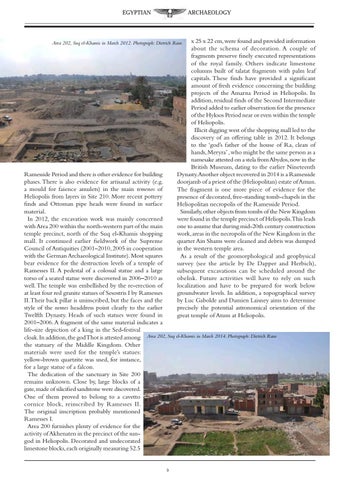
Area 202, Suq el-Khamis in March 2012. Photograph: Dietrich Raue.
Ramesside Period and there is other evidence for building phases. There is also evidence for artisanal activity (e.g. a mould for faience amulets) in the main temenos of Heliopolis from layers in Site 210. More recent pottery finds and Ottoman pipe heads were found in surface material. In 2012, the excavation work was mainly concerned with Area 200 within the north-western part of the main temple precinct, north of the Suq el-Khamis shopping mall. It continued earlier fieldwork of the Supreme Council of Antiquities (2001–2010, 2005 in cooperation with the German Archaeological Institute). Most squares bear evidence for the destruction levels of a temple of Ramesses II. A pedestal of a colossal statue and a large torso of a seated statue were discovered in 2006–2010 as well. The temple was embellished by the re-erection of at least four red granite statues of Sesostris I by Ramesses II. Their back pillar is uninscribed, but the faces and the style of the nemes headdress point clearly to the earlier Twelfth Dynasty. Heads of such statues were found in 2001–2006. A fragment of the same material indicates a life-size depiction of a king in the Sed-festival cloak. In addition, the god Thot is attested among Area 202, Suq el-Khamis in March 2014. Photograph: Dietrich Raue the statuary of the Middle Kingdom. Other materials were used for the temple’s statues: yellow-brown quartzite was used, for instance, for a large statue of a falcon. The dedication of the sanctuary in Site 200 remains unknown. Close by, large blocks of a gate, made of silicified sandstone were discovered. One of them proved to belong to a cavetto cornice block, reinscribed by Ramesses II. The original inscription probably mentioned Ramesses I. Area 200 furnishes plenty of evidence for the activity of Akhenaten in the precinct of the sungod in Heliopolis. Decorated and undecorated limestone blocks, each originally measuring 52.5 9