EGYPTIAN
ARCHAEOLOGY
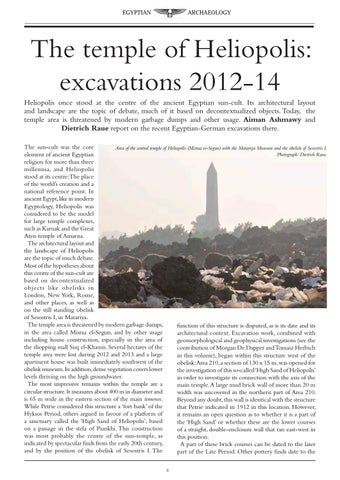
The temple of Heliopolis: excavations 2012-14 Heliopolis once stood at the centre of the ancient Egyptian sun-cult. Its architectural layout and landscape are the topic of debate, much of it based on decontextualized objects. Today, the temple area is threatened by modern garbage dumps and other usage. Aiman Ashmawy and Dietrich Raue report on the recent Egyptian-German excavations there. The sun-cult was the core Area of the central temple of Heliopolis (Misraa es-Segun) with the Matariya Museum and the obelisk of Sesostris I. Photograph: Dietrich Raue. element of ancient Egyptian religion for more than three millennia, and Heliopolis stood at its centre: The place of the world’s creation and a national reference point. In ancient Egypt, like in modern Egyptology, Heliopolis was considered to be the model for large temple complexes, such as Karnak and the Great Aten temple of Amarna. The architectural layout and the landscape of Heliopolis are the topic of much debate. Most of the hypotheses about this centre of the sun-cult are based on decontextualized objects like obelisks in London, New York, Rome, and other places, as well as on the still standing obelisk of Sesostris I, in Matariya. The temple area is threatened by modern garbage dumps, function of this structure is disputed, as is its date and its in the area called Misraa el-Segun, and by other usage architectural context. Excavation work, combined with including house construction, especially in the area of geomorphological and geophysical investigations (see the the shopping mall Suq el-Khamis. Several hectares of the contribution of Morgan De Dapper and Tomasz Herbich temple area were lost during 2012 and 2013 and a large in this volume), began within this structure west of the apartment house was built immediately southwest of the obelisk:Area 210, a section of 130 x 15 m, was opened for obelisk museum. In addition, dense vegetation covers lower the investigation of this so-called ‘High Sand of Heliopolis’ levels thriving on the high groundwater. in order to investigate its connection with the axis of the The most impressive remains within the temple are a main temple. A large mud brick wall of more than 20 m circular structure. It measures about 400 m in diameter and width was uncovered in the northern part of Area 210. is 65 m wide in the eastern section of the main temenos. Beyond any doubt, this wall is identical with the structure While Petrie considered this structure a ‘fort bank’ of the that Petrie indicated in 1912 in this location. However, Hyksos Period, others argued in favour of a platform of it remains an open question as to whether it is a part of a sanctuary called the ‘High Sand of Heliopolis’, based the ‘High Sand’ or whether these are the lower courses on a passage in the stela of Piankhi. This construction of a straight, double-enclosure wall that ran east-west in was most probably the centre of the sun-temple, as this position. indicated by spectacular finds from the early 20th century, A part of these brick courses can be dated to the later and by the position of the obelisk of Sesostris I. The part of the Late Period. Other pottery finds date to the 8