EGYPTIAN
ARCHAEOLOGY
temple might have been destroyed because of a steep drop in the level of the mound, but in fact we found the rear wall of the structure still present, except for the exterior of the north corner, which had been eroded down below its foundation. The rear west corner has survived – just – with the remains of the foundation courses reduced to a brick and a half. The drop in level proved to be useful in that it enabled us to reach the foundation level of the whole building, pretty much at the base of the high mound in the surrounding flat zone. Here it was possible to see the layers over which the temple wall had been built, which consisted of settlement debris with pottery of the late New Kingdom. Since the fill above the temple, although it consists mainly of compacted empty layers of mud, contains some pottery sherds from the end of the Third Intermediate Period and early Late Period, the temple appears to sit in a stratigraphic sequence between about 1300 BC and 700 BC, so a construction date in the Ramesside Period seems most likely. After exploring the outer perimeter of the temple, we investigated the interior. The only internal walls we were able to locate were those surrounding a sanctuary area of c.24m x 13.5m, with a central entrance at the front, on the axis of the temple. This entrance was 2m wide through a front wall 2.9m thick, while the side walls were each 4.5m in thickness. Each side wall was connected to the rear wall of the temple at the north-west. This area of the building is located at the highest part of the ancient mound so the walls of the sanctuary are actually preserved to a height of over five metres above the level of the temple floor at the gate, which is itself 3.4m above the foundation level of the building. None of the walls are visible above the present ground surface, however, because the whole temple has been buried in a combination of wind-blown dust and material from the erosion of its own walls, with some later fill dumped above. To the south of the temple lay the casemate foundation
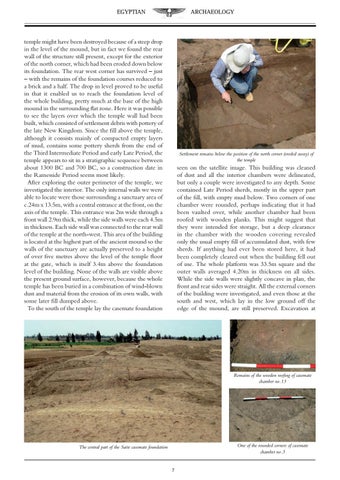
Settlement remains below the position of the north corner (eroded away) of the temple
seen on the satellite image. This building was cleaned of dust and all the interior chambers were delineated, but only a couple were investigated to any depth. Some contained Late Period sherds, mostly in the upper part of the fill, with empty mud below. Two corners of one chamber were rounded, perhaps indicating that it had been vaulted over, while another chamber had been roofed with wooden planks. This might suggest that they were intended for storage, but a deep clearance in the chamber with the wooden covering revealed only the usual empty fill of accumulated dust, with few sherds. If anything had ever been stored here, it had been completely cleared out when the building fell out of use. The whole platform was 33.5m square and the outer walls averaged 4.20m in thickness on all sides. While the side walls were slightly concave in plan, the front and rear sides were straight. All the external corners of the building were investigated, and even those at the south and west, which lay in the low ground off the edge of the mound, are still preserved. Excavation at
Remains of the wooden roofing of casemate chamber no.13
One of the rounded corners of casemate chamber no.3
The central part of the Saite casemate foundation