EGYPTIAN
ARCHAEOLOGY
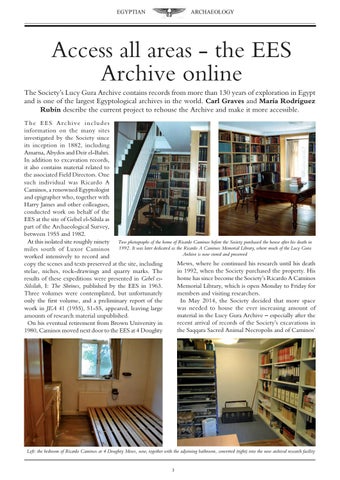
Access all areas - the EES Archive online The Society’s Lucy Gura Archive contains records from more than 130 years of exploration in Egypt and is one of the largest Egyptological archives in the world. Carl Graves and María Rodríguez Rubín describe the current project to rehouse the Archive and make it more accessible. The EES Archive includes information on the many sites investigated by the Society since its inception in 1882, including Amarna, Abydos and Deir el-Bahri. In addition to excavation records, it also contains material related to the associated Field Directors. One such individual was Ricardo A Caminos, a renowned Egyptologist and epigrapher who, together with Harry James and other colleagues, conducted work on behalf of the EES at the site of Gebel el-Silsila as part of the Archaeological Survey, between 1955 and 1982. At this isolated site roughly ninety Two photographs of the home of Ricardo Caminos before the Society purchased the house after his death in miles south of Luxor Caminos 1992. It was later dedicated as the Ricardo A Caminos Memorial Library, where much of the Lucy Gura Archive is now stored and preserved worked intensively to record and Mews, where he continued his research until his death copy the scenes and texts preserved at the site, including in 1992, when the Society purchased the property. His stelae, niches, rock-drawings and quarry marks. The home has since become the Society’s Ricardo A Caminos results of these expeditions were presented in Gebel esMemorial Library, which is open Monday to Friday for Silsilah, I: The Shrines, published by the EES in 1963. members and visiting researchers. Three volumes were contemplated, but unfortunately In May 2014, the Society decided that more space only the first volume, and a preliminary report of the was needed to house the ever increasing amount of work in JEA 41 (1955), 51-55, appeared, leaving large material in the Lucy Gura Archive – especially after the amounts of research material unpublished. recent arrival of records of the Society’s excavations in On his eventual retirement from Brown University in the Saqqara Sacred Animal Necropolis and of Caminos’ 1980, Caminos moved next door to the EES at 4 Doughty
Left: the bedroom of Ricardo Caminos at 4 Doughty Mews, now, together with the adjoining bathroom, converted (right) into the new archival research facility