EGYPTIAN
since the late 1970s, the call to research the non-elite in ancient Egyptian society, thus proclaiming a new agenda in the wake of the cultural theorist Stuart Hall’s semiotic approach to cultural achievements. Although most scholars today feel uneasy about the term ‘high culture’, Baines’s approach to social class distinction helps him to identify the primary evidence necessary to focus on the experience of at least the highest class of the ancient Egyptian social pyramid. It is needless to say that their experiences never matched those of Egyptians lower down the social pyramid. In the Introduction this carefully produced book sets out the methodological approach and the obvious challenges in a context where those expressing experience were limited by rules set up to define what was appropriate for being displayed (decorum). But as this book deals with sociology rather than the consumption of aesthetics, its author also convincingly shows that the leisured classes were striving for enjoyment, celebration and appreciation of the finer things in life. The first chapter argues that the elite manipulated the landscape to achieve exactly these aims both in cities and rural areas where they played a dominant role. Baines includes travelling and commuting as ‘integral to elite identities’. Unfortunately, the difference between elite travel and that of ordinary people commuting to work places, such as to Elephantine during the Old Kingdom, are not spelled out. Often, it seems, the absence of evidence is taken as evidence for absence and one would like to argue that, for example, travelling was an integral part of any social group’s identity; it is merely the quality of travel that differed when towns and villages became inundated due to the ever-changing course of the Nile and some became homeless while others, having built on higher ground, could choose to remain. Landscape obviously changed considerably under the influence of humans, and cultural landscapes are the result of human activities. According to Baines, the garden epitomises this approach (the word ‘culture’ after all derives from Latin cultura) and he mainly uses evidence from tombs to support his point of the ‘celebration of ordered abundance’. We know little about villas in the countryside but one would suspect that even well-off city dwellers had their gardens or allotments elsewhere, as in towns like Elephantine gardens have not been identified to any great extent. But Baines rightly points out that his interest is not in gardens that are maintained to help families to make ends meet but in those that celebrated excellence, although these have not been excavated. His passage about the hunting party during the reign of Amenhotep II makes clear that untamed nature was also included in this overarching concept. In the last chapter experience is fully discussed and the importance of the display of personal achievement and self-presentation, or in other words presence as an expression of power, convincingly flagged up. It becomes
ARCHAEOLOGY
clear throughout the book that, according to Baines, the elite’s expression of experience (or self-reference?) has to do with the display of pleasure and supremacy more than anything else. However, it would also have been interesting to learn what the elite’s religious experience looked like, in an attempt hopefully to understand better the religious practice of non-elite classes as well. But then, again, it is still almost impossible to draw the lines between the many different levels of ancient Egyptian society. MARTIN BOMMAS
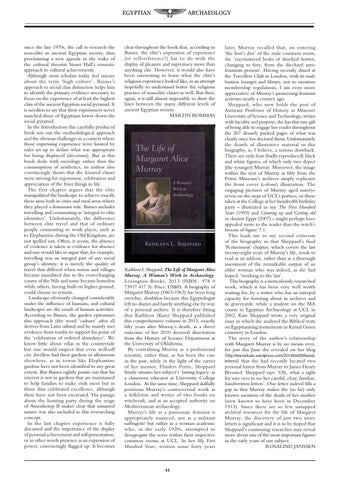
Kathleen L Sheppard, The Life of Margaret Alice Murray. A Woman’s Work in Archaeology. Lexington Books, 2013 (ISBN 978 0 73917 417 3). Price: US$85. A biography of Margaret Murray (1863-1963) has been long overdue, doubtless because this Egyptologist left no diaries and barely anything else by way of a personal archive. It is therefore fitting that Kathleen (Kate) Sheppard published this comprehensive volume in 2013, exactly fifty years after Murray’s death, as a direct outcome of her 2010 doctoral dissertation from the History of Science Department at the University of Oklahoma. By centralising Murray as a professional scientist, rather than, as has been the case in the past, solely in the light of the career of her mentor, Flinders Petrie, Sheppard firmly situates her subject’s lasting legacy: as a classroom educator at University College London. At the same time, Sheppard skilfully positions Murray’s controversial work as a folklorist and writer of two books on witchcraft, and as an accepted authority on Mediterranean archaeology. Murray’s life as a passionate feminist is appropriately nuanced, not as a militant suffragette but rather as a woman academic who, in the early 1920s, attempted to desegregate the sexes within their respective common rooms at UCL. In her My First Hundred Years, written some forty years
44
later, Murray recalled that, on entering ‘the lion’s den’ of the male common room, she ‘encountered looks of shocked horror, changing to fury, from the die-hard antifeminists present’. Having recently dined at the Travellers Club in London, with its male bastion lounges and library, not to mention membership regulations, I am even more appreciative of Murray’s pioneering feminist activism nearly a century ago. Sheppard, who now holds the post of Assistant Professor of History at Missouri University of Science and Technology, writes with lucidity and purpose; she has that rare gift of being able to engage her reader throughout the 267 densely packed pages of what was clearly once her doctoral thesis. Unfortunately the dearth of illustrative material in this biography, is, I believe, a serious drawback. There are only four (badly reproduced) black and white figures, of which only two depict (the younger) Murray. Moreover, the image within the text of Murray at fifty from the Petrie Museum’s archives simply replicates the front cover (colour) illustration. The engaging pictures of Murray aged ninetyseven on the steps of UCL’s portico, or those taken at the College at her hundredth birthday party - illustrated in my The First Hundred Years (1993) and Growing up and Getting old in Ancient Egypt (2007) - might perhaps have appealed more to the reader than the witch’s broom of figure 7.1. This leads me to my second criticism of the biography in that Sheppard’s final ‘Retirement’ chapter, which covers the last twenty-eight years of Murray’s life, tends to read as an add-on, rather than as a thorough assessment of the remarkable output of an older woman who was indeed, as she had hoped, ‘working to the last’. This biography is a meticulously researched work, which it has been very well worth waiting for, by a writer who has an intrepid capacity for ferreting about in archives and in graveyards: while a student on the MA course in Egyptian Archaeology at UCL in 2002, Kate Sheppard wrote a very original essay in which she analysed the Biblical texts on Egyptianising monuments in Kensal Green cemetery in London. The story of the author’s relationship with Margaret Murray is by no means over, for just this June she revealed on her blog (http://doctorkate.wordpress.com/2014/06/09/foundletters/) that she had recently located two personal letters from Murray to James Henry Breasted. Sheppard says: ‘Oh, what a sight for sore eyes to see her careful, clear, familiar, handwritten letters’. One letter indeed fills a gap in that Murray makes the (so far) only known mention of the death of her mother (now known to have been in December 1913). Since there are so few untapped archival resources for the life of Margaret Murray, the discovery of just two more letters is significant and it is to be hoped that Sheppard’s continuing researches may reveal more about one of the most important figures in the early years of our subject. ROSALIND JANSSEN