EGYPTIAN
each, and I noted a marked emphasis on later periods of Egyptian history, at the expense of the Old Kingdom. There are some examples of downright incorrect or misleading information such as the demonstrably false statement that ‘wreaths of flowers were lying on the sarcophagus of Tutankhamun when it was discovered’ (p.144). The answer to No.86 (‘Why did elite Egyptians not wear beards?’) that the only facial hair ‘allowed was the moustache’ ignores the countless examples of officials and dignitaries depicted with fashionable chin beards. Some of Schneider’s opinions and interpretations astonished me. One of them is the twist he gives to the idea, currently in vogue, that a plague played an important role in the history of the later Eighteenth Dynasty: he suggests that the Amarna episode could have resulted when, to overcome the ravages of this plague, ‘the elite of the state might have decided, as a last resort, to give Akhenaten a free hand in introducing a new religion’. And in the answer to Question 87: ‘Are Niankhkhnum and Khnumhotep the first attested gay couple?’ Schneider presents the idea that these men were Siamese twins as if it were worthy of serious consideration. The answer to this question also points up one shortcoming of the book: nowhere is it mentioned when these men lived. The names of Kings Unas and Niuserre are cited in the answer, but in the ‘timeline’ provided for
ARCHAEOLOGY
readers’ chronological orientation on pp. x-xi, only dates for Dynasties are given without any king’s names. This is a definite disservice to the general reader, since dates or references to Dynasty are not consistently cited when pharaohs’ names occur in the text. The few monochrome illustrations have been chosen at random and the captions for some of them are garbled or simply wrong. For example, Nun (the primaeval ocean in an Egyptian creation myth) is called ‘the god of the skies’ in the caption to Fig.3 and in Fig.14 ‘two royal women of the time of King Amenophis [sic – elsewhere consistently Amenhotep] III’ are said to be ‘each wearing [!] a sistrum’. Schneider dedicates this book to the memory of David Lorton who prepared the translation. It’s indeed a pity that Lorton did not live to see it through the press, since the final printed text (described, p. xiv, as his translation ‘somewhat adjusted and [with] some articles substituted’) is not up to his standard. MARIANNE EATON-KRAUSS John Baines, High Culture and Experience in Ancient Egypt. Equinox Publishing Ltd, 2013 (ISBN 978 1 84553 300 7). Price: £60. This book is comprised of five studies suggesting the existence of an elite experience in ancient Egypt. Social sharing of experiences is a relatively new field of research that is not only investigated in the field of psychology but also in that of sociology and it is certainly
important to distinguish between social groups before Egyptologists can seriously dig new trenches. The raising of awareness for this promising new field of research is certainly to be welcomed warmly, especially since it is suggested by a scholar who in the past did not suffer the discipline’s focus on Hochkulturen gladly. John Baines belongs to a group of mostly British Egyptologists who have spearheaded,
PAPERS ON ARCHAEOLOGY FROM THE LEIDEN MUSEUM OF ANTIQUITIES
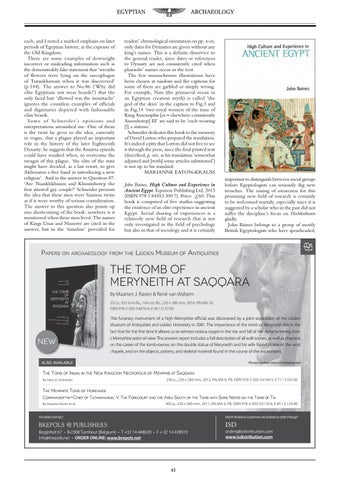
The Tomb of Meryneith at Saqqara Saqqara By Maarten J. Raven & René van Walsem 352 p., 925 b/w ills., 164 col. ills., 220 x 280 mm, 2014, PALMA 10, ISBN 978-2-503-54876-0, € 94 / $137.00
NEW
This funerary monument of a high Memphite official was discovered by a joint expedition of the Leiden Museum of Antiquities and Leiden University in 2001. The importance of the tomb of Meryneith lies in the fact that for the first time it allows us to witness various stages in the rise and fall of the Amarna heresy from a Memphite point of view. The present report includes a full description of all wall scenes, as well as chapters on the career of the tomb-owner, on the double statue of Meryneith and his wife found in one of the west chapels, and on the objects, pottery, and skeletal material found in the course of the excavations.
ALSO AVAILABLE
All prices exclude taxes and shipping costs
THE TOMB OF INIUIA IN THE NEW KINGDOM NECROPOLIS OF MEMPHIS AT SAQQARA By Hans D. Schneider
240 p., 220 x 280 mm, 2012, PALMA 8, PB, ISBN 978-2-503-54149-5, € 71 / $103.00
THE MEMPHITE TOMB OF HOREMHEB COMMANDER-IN-CHIEF OF TUTANKHAMUN, V: THE FORECOURT AND THE AREA SOUTH OF THE TOMB WITH SOME NOTES ON THE TOMB OF TIA By Maarten Raven et al.
403 p., 220 x 280 mm, 2011, PALMA 6, PB, ISBN 978-2-503-53110-6, € 85 / $ 124.00
For orders contact:
North-American customers are advised to order through:
ISD Begijnhof 67 - B-2300 Turnhout (Belgium) - T +32 14 448020 - F + 32 14 428919 info@brepols.net - ORDER ONLINE: www.brepols.net
43
orders@isdistribution.com www.isdistribution.com