EGYPTIAN
ARCHAEOLOGY
Bookshelf
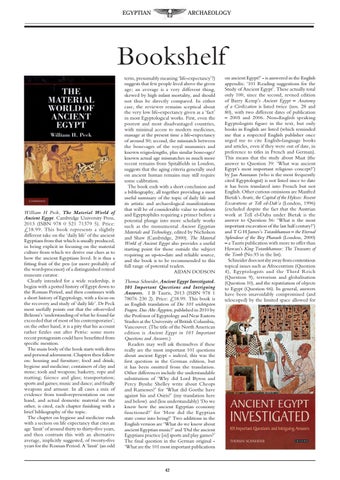
William H Peck, The Material World of Ancient Egypt. Cambridge University Press, 2013 (ISBN 978 0 521 71379 5). Price: £18.99. This book represents a slightly different take on the ‘daily life’ of the ancient Egyptians from that which is usually produced, in being explicit in focusing on the material culture from which we derive our clues as to how the ancient Egyptians lived. It is thus a fitting fruit of the pen (or more probably of the word-processor) of a distinguished retired museum curator. Clearly intended for a wide readership, it begins with a potted history of Egypt down to the Roman Period, and then continues with a short history of Egyptology, with a focus on the recovery and study of ‘daily life’. Dr Peck most usefully points out that the oft-reviled Belzoni’s ‘understanding of what he found far exceeded that of most of his contemporaries’; on the other hand, it is a pity that his account rather fizzles out after Petrie: some more recent protagonists could have benefitted from specific mention. The main body of the book starts with dress and personal adornment. Chapters then follow on: housing and furniture; food and drink; hygiene and medicine; containers of clay and stone; tools and weapons; basketry, rope and matting; faience and glass; transportation; sports and games; music and dance; and finally weapons and armour. In all cases a mix of evidence from tomb-representation on one hand, and actual domestic material on the other, is cited, each chapter finishing with a brief bibliography of the topic. The chapter on hygiene and medicine ends with a section on life expectancy that cites an age ‘limit’ of around thirty to thirty-five years, and then contrasts this with an alternative average, implicitly suggested, of twenty-five years for the Roman Period. A ‘limit’ (an odd
term, presumably meaning ‘life-expectancy’?) suggests that few people lived above the given age; an average is a very different thing, skewed by high infant mortality, and should not thus be directly compared. In either case, the reviewer remains sceptical about the very low life-expectancy given as a ‘fact’ in most Egyptological works. First, even the poorest and most disadvantaged countries, with minimal access to modern medicines, manage at the present time a life-expectancy of around 50; second, the mismatch between the bone-ages of the royal mummies and known reign-lengths, plus similar bone-age/ known actual age mismatches in much more recent remains from Spitalfields in London, suggests that the aging criteria generally used on ancient human remains may still require some calibration. The book ends with a short conclusion and a bibliography, all together providing a most useful summary of the topic of daily life and its artistic and archaeological manifestations that will be of considerable value to students and Egyptophiles requiring a primer before a potential plunge into more scholarly works such as the monumental Ancient Egyptian Materials and Technology, edited by Nicholson and Shaw (Cambridge, 2000). The Material World of Ancient Egypt also provides a useful starting point for those outside the subject requiring an up-to-date and reliable source, and the book is to be recommended to this full range of potential readers. AIDAN DODSON Thomas Schneider, Ancient Egypt Investigated. 101 Important Questions and Intriguing Answers. I B Tauris, 2013 (ISBN 978 1 78076 230 2). Price: £18.99. This book is an English translation of Die 101 wichtigsten Fragen. Das Alte Ägypten, published in 2010 by the Professor of Egyptology and Near Eastern Studies at the University of British Columbia, Vancouver. (The title of the North American edition is Ancient Egypt in 101 Important Questions and Answers.) Readers may well ask themselves if these really are the most important 101 questions about ancient Egypt - indeed, this was the first question in the German edition, but it has been omitted from the translation. Other differences include the understandable substitution of ‘Why did Lord Byron and Percy Bysshe Shelley write about Cheops and Ramesses?’ for ‘What did Goethe have against Isis and Osiris?’ (my translation here and below) and (less understandably) ‘Do we know how the ancient Egyptian economy functioned?’ for ‘How did the Egyptian state come into being?’ Two additions in the English version are ‘What do we know about ancient Egyptian music?’ and ‘Did the ancient Egyptians practice [sic] sports and play games?’ The final question in the German original ‘What are the 101 most important publications
42
on ancient Egypt?’ - is answered in the English appendix: ‘101 Reading suggestions for the Study of Ancient Egypt’. These actually total only 100, since the second, revised edition of Barry Kemp’s Ancient Egypt – Anatomy of a Civilization is listed twice (nos. 28 and 80), with two different dates of publication – 2005 and 2006. Non-English speaking Egyptologists figure in the text, but only books in English are listed (which reminded me that a respected English publisher once urged me to cite English-language books and articles, even if they were out of date, in preference to titles in French and German). This means that the study about Maat (the answer to Question 39: ‘What was ancient Egypt’s most important religious concept?’) by Jan Assmann (who is the most frequently cited Egyptologist) is not listed since to date it has been translated into French but not English. Other curious omissions are Manfred Bietak’s Avaris, the Capital of the Hyksos: Recent Excavations at Tell ed-Dab’a (London, 1996) (excluded despite the fact that the Austrian work at Tell el-Daba under Bietak is the answer to Question 56: ‘What is the most important excavation of the last half century?’) and T G H James’s Tutankhamun – the Eternal Splendour of the Boy Pharaoh (London, 2000) – a Tauris publication with more to offer than Hawass’s King Tutankhamun: The Treasures of the Tomb (No.93 in the list). Schneider does not shy away from contentious topical issues such as Afrocentrism (Question 4), Egyptologists and the Third Reich (Question 9), terrorism and globalisation (Question 10), and the repatriation of objects to Egypt (Question 66). In general, answers have been unavoidably compromised (and telescoped) by the limited space allowed for