EGYPTIAN
ARCHAEOLOGY
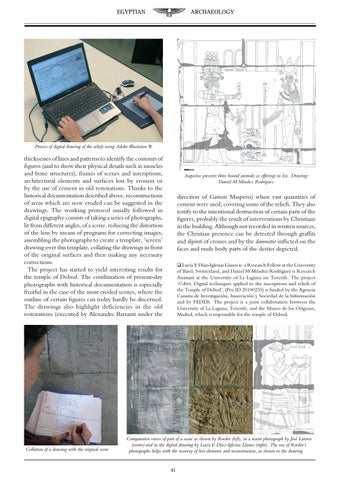
Process of digital drawing of the reliefs using Adobe Illustrator ®
thicknesses of lines and patterns to identify the contours of figures (and to show their physical details such as muscles and bone structures), frames of scenes and inscriptions, architectural elements and surfaces lost by erosion or by the use of cement in old restorations. Thanks to the historical documentation described above, reconstructions of areas which are now eroded can be suggested in the drawings. The working protocol usually followed in digital epigraphy consists of taking a series of photographs, lit from different angles, of a scene, reducing the distortion of the lens by means of programs for correcting images, assembling the photographs to create a template, ‘screen’ drawing over this template, collating the drawings in front of the original surfaces and then making any necessary corrections. The project has started to yield interesting results for the temple of Debod. The combination of present-day photographs with historical documentation is especially fruitful in the case of the most eroded scenes, where the outline of certain figures can today hardly be discerned. The drawings also highlight deficiencies in the old restorations (executed by Alexandre Barsanti under the
Collation of a drawing with the original scene
Augustus presents three bound animals as offerings to Isis. Drawing: Daniel M Méndez Rodríguez
direction of Gaston Maspero) when vast quantities of cement were used, covering some of the reliefs. They also testify to the intentional destruction of certain parts of the figures, probably the result of interventions by Christians in the building. Although not recorded in written sources, the Christian presence can be detected through graffiti and dipinti of crosses and by the damnatio inflicted on the faces and nude body parts of the deities depicted. q Lucía E Díaz-Iglesias Llanos is a Research Fellow at the University of Basel, Switzerland, and Daniel M Méndez Rodríguez is Research Assistant at the University of La Laguna on Tenerife. The project ‘tA-Hwt, Digital techniques applied to the inscriptions and reliefs of the Temple of Debod’, (Pro ID 20100235) is funded by the Agencia Canaria de Investigación, Innovación y Sociedad de la Información and by FEDER. The project is a joint collaboration between the University of La Laguna, Tenerife, and the Museo de los Orígenes, Madrid, which is responsible for the temple of Debod.
Comparative views of part of a scene as shown by Roeder (left), in a recent photograph by José Latova (centre) and in the digital drawing by Lucía E Díaz-Iglesias Llanos (right). The use of Roeder’s photographs helps with the recovery of lost elements and reconstruction, as shown in the drawing 41