EGYPTIAN
ARCHAEOLOGY
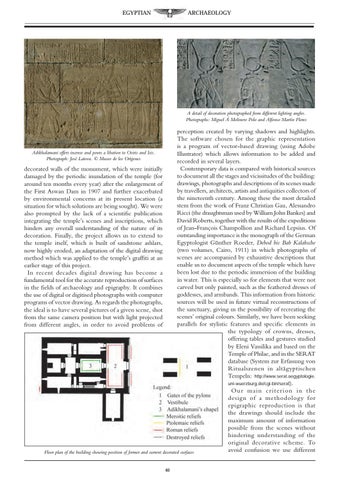
A detail of decoration photographed from different lighting angles. Photographs: Miguel Á Molinero Polo and Alfonso Martín Flores
perception created by varying shadows and highlights. The software chosen for the graphic representation is a program of vector-based drawing (using Adobe Adikhalamani offers incense and pours a libation to Osiris and Isis. Illustrator) which allows information to be added and Photograph: José Latova. © Museo de los Orígenes recorded in several layers. Contemporary data is compared with historical sources decorated walls of the monument, which were initially to document all the stages and vicissitudes of the building: damaged by the periodic inundation of the temple (for drawings, photographs and descriptions of its scenes made around ten months every year) after the enlargement of by travellers, architects, artists and antiquities collectors of the First Aswan Dam in 1907 and further exacerbated the nineteenth century. Among these the most detailed by environmental concerns at its present location (a stem from the work of Franz Christian Gau, Alessandro situation for which solutions are being sought). We were Ricci (the draughtsman used by William John Bankes) and also prompted by the lack of a scientific publication David Roberts, together with the results of the expeditions integrating the temple’s scenes and inscriptions, which of Jean-François Champollion and Richard Lepsius. Of hinders any overall understanding of the nature of its outstanding importance is the monograph of the German decoration. Finally, the project allows us to extend to Egyptologist Günther Roeder, Debod bis Bab Kalabsche the temple itself, which is built of sandstone ashlars, (two volumes, Cairo, 1911) in which photographs of now highly eroded, an adaptation of the digital drawing scenes are accompanied by exhaustive descriptions that method which was applied to the temple’s graffiti at an enable us to document aspects of the temple which have earlier stage of this project. been lost due to the periodic immersion of the building In recent decades digital drawing has become a in water. This is especially so for elements that were not fundamental tool for the accurate reproduction of surfaces carved but only painted, such as the feathered dresses of in the fields of archaeology and epigraphy. It combines goddesses, and armbands. This information from historic the use of digital or digitised photographs with computer sources will be used in future virtual reconstructions of programs of vector drawing. As regards the photographs, the sanctuary, giving us the possibility of recreating the the ideal is to have several pictures of a given scene, shot scenes’ original colours. Similarly, we have been seeking from the same camera position but with light projected parallels for stylistic features and specific elements in from different angles, in order to avoid problems of the typology of crowns, dresses, offering tables and gestures studied by Eleni Vassilika and based on the Temple of Philae, and in the SERAT database (System zur Erfassung von Ritualszenen in altägyptischen Tempeln: http://www.serat.aegyptologie. uni-wuerzburg.de/cgi-bin/serat). Our main criterion in the design of a methodology for epigraphic reproduction is that the drawings should include the maximum amount of information possible from the scenes without hindering understanding of the original decorative scheme. To avoid confusion we use different Floor plan of the building showing position of former and current decorated surfaces 40