EGYPTIAN
ARCHAEOLOGY
Digital epigraphy of the temple of Debod A Spanish team is currently applying the latest digital recording techniques to a study of the scenes and inscriptions of the Nubian temple from Debod, now in Madrid, as Lucía E Díaz-Iglesias Llanos and Daniel M Méndez Rodríguez describe. of the uprising of the Theban area against Alexandria at the end of the third century AD; the iconographic programme highlights the importance of a new local theological creation (Amun as divine father of the king of Meroe) and the central role played by the nearby temple of Isis in Philae in the cultic network of small chapels in the area; and the religious background of the decoration, with its balance of representations of Nubian and Egyptian deities, exemplifies the political and religious developments in the Dodekaschoinos. Our project ‘tA-Hwt, Digital Techniques applied to the Inscriptions and Reliefs of the Temple of Debod’, directed by Miguel Á Molinero Polo of the University of La Laguna, Tenerife, has a multi-disciplinary team composed of Egyptologists, graphic designers, computer technicians and architects. The project’s research focuses on the recording, study, and publication of the inscriptions and scenes of Debod’s temple, which will allow us to create a digital reconstruction of the building in the future. The aim is to render an accurate copy of its scenes and texts by means of digital epigraphic techniques and to analyze the rules that underlie the decorative programme. The project was started because of the slow erosion of the
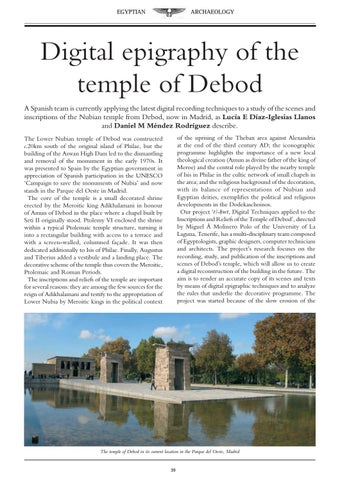
The Lower Nubian temple of Debod was constructed c.20km south of the original island of Philae, but the building of the Aswan High Dam led to the dismantling and removal of the monument in the early 1970s. It was presented to Spain by the Egyptian government in appreciation of Spanish participation in the UNESCO ‘Campaign to save the monuments of Nubia’ and now stands in the Parque del Oeste in Madrid. The core of the temple is a small decorated shrine erected by the Meroitic king Adikhalamani in honour of Amun of Debod in the place where a chapel built by Seti II originally stood. Ptolemy VI enclosed the shrine within a typical Ptolemaic temple structure, turning it into a rectangular building with access to a terrace and with a screen-walled, columned façade. It was then dedicated additionally to Isis of Philae. Finally, Augustus and Tiberius added a vestibule and a landing place. The decorative scheme of the temple thus covers the Meroitic, Ptolemaic and Roman Periods. The inscriptions and reliefs of the temple are important for several reasons: they are among the few sources for the reign of Adikhalamani and testify to the appropriation of Lower Nubia by Meroitic kings in the political context
The temple of Debod in its current location in the Parque del Oeste, Madrid 39