EGYPTIAN
ARCHAEOLOGY
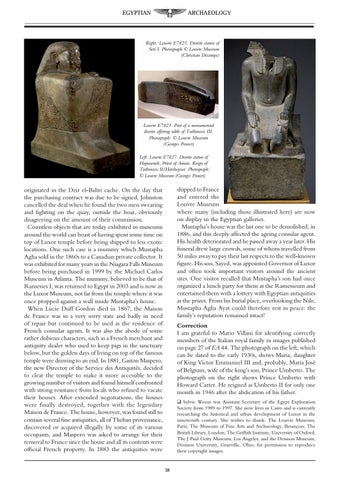
Right: Louvre E7825. Diorite statue of Seti I. Photograph © Louvre Museum (Christian Décamps)
Louvre E7823. Part of a monumental diorite offering table of Tuthmosis III. Photograph: © Louvre Museum (Georges Poncet) Left: Louvre E7827. Diorite statue of Hapuseneb, Priest of Amun. Reign of Tuthmosis II/Hatshepsut. Photograph: © Louvre Museum (Georges Poncet)
shipped to France and entered the Louvre Museum where many (including those illustrated here) are now on display in the Egyptian galleries. Mustapha’s house was the last one to be demolished, in 1886, and this deeply affected the ageing consular agent. His health deteriorated and he passed away a year later. His funeral drew large crowds, some of whom travelled from 50 miles away to pay their last respects to the well-known figure. His son, Sayed, was appointed Governor of Luxor and often took important visitors around the ancient sites. One visitor recalled that Mustapha’s son had once organized a lunch party for them at the Ramesseum and entertained them with a lottery with Egyptian antiquities as the prizes. From his burial place, overlooking the Nile, Mustapha Agha Ayat could therefore rest in peace: the family’s reputation remained intact!
originated in the Deir el-Bahri cache. On the day that the purchasing contract was due to be signed, Johnston cancelled the deal when he found the two men swearing and fighting on the quay, outside the boat, obviously disagreeing on the amount of their commission. Countless objects that are today exhibited in museums around the world can boast of having spent some time on top of Luxor temple before being shipped to less exotic locations. One such case is a mummy which Mustapha Agha sold in the 1860s to a Canadian private collector. It was exhibited for many years in the Niagara Falls Museum before being purchased in 1999 by the Michael Carlos Museum in Atlanta. The mummy, believed to be that of Ramesses I, was returned to Egypt in 2003 and is now in the Luxor Museum, not far from the temple where it was once propped against a wall inside Mustapha’s house. When Lucie Duff Gordon died in 1867, the Maison de France was in a very sorry state and badly in need of repair but continued to be used as the residence of French consular agents. It was also the abode of some rather dubious characters, such as a French merchant and antiquity dealer who used to keep pigs in the sanctuary below, but the golden days of living on top of the famous temple were drawing to an end. In 1881, Gaston Maspero, the new Director of the Service des Antiquités, decided to clear the temple to make it more accessible to the growing number of visitors and found himself confronted with strong resistance from locals who refused to vacate their houses. After extended negotiations, the houses were finally destroyed, together with the legendary Maison de France. The house, however, was found still to contain several fine antiquities, all of Theban provenance, discovered or acquired illegally by some of its various occupants, and Maspero was asked to arrange for their removal to France since the house and all its contents were official French property. In 1883 the antiquities were
Correction I am grateful to Mario Villani for identifying correctly members of the Italian royal family in images published on page 27 of EA 44. The photograph on the left, which can be dated to the early 1930s, shows Maria, daughter of King Victor Emmanuel III and, probably, Maria José of Belgium, wife of the king’s son, Prince Umberto. The photograph on the right shows Prince Umberto with Howard Carter. He reigned as Umberto II for only one month in 1946 after the abdication of his father. q Sylvie Weens was Assistant Secretary of the Egypt Exploration Society from 1989 to 1997. She now lives in Cairo and is currently researching the historical and urban development of Luxor in the nineteenth century. She wishes to thank: The Louvre Museum, Paris; The Museum of Fine Arts and Archaeology, Besançon; The British Library, London; The Griffith Institute, University of Oxford; The J Paul Getty Museum, Los Angeles; and the Denison Museum, Denison University, Granville, Ohio, for permission to reproduce their copyright images. 38