EGYPTIAN
ARCHAEOLOGY
Some editorial musings
Since this is my last editorial I hope you will not mind if I indulge myself and muse a little on the history and evolution of Egyptian Archaeology. By the 1980s there was a growing feeling at the EES that there was a need in the subject for a regular publication which presented the results of fieldwork and research in a more accessible way than was possible in the more weighty Egyptological journals, such as our own JEA. The first tentative steps were taken in 1987 with the production of a Newsletter which included an article by Barry Kemp on the Amarna dig-house, brief summaries of recent EES fieldwork and a list of publications. Although uncredited (clearly I did not have editorial control!) there is also a short account that I wrote about the removal of heavy antiquities from Bubastis a century earlier in 1887 - the outcome of my first real foray into the extensive archives at the Society. Six issues of the Newsletter, compiled and edited by David Jeffreys and Ian Shaw, appeared over the next two years and the final issue in October 1989 announced that it would be replaced from 1991 by Egyptian Archaeology ‘a 32-page magazine with a colour cover and colour illustrations within the text’. All six issues of the Newsletter can be downloaded from the EES website: www.ees.ac.uk/news/EESNewsletters.html I remember much discussion as to what the name of the new magazine should be (Petrie Papers was one of the suggestions - quickly voted down) but the eventual title chosen has proved to be ideal, both describing succinctly the content and also referencing the magazine’s older sibling, the Journal of Egyptian Archaeology. The first issue of EA, edited by Mike Murphy, was published in 1991 and the content focused on EES fieldwork with one ‘guest’ article by Alain Zivie on his excavation at Saqqara. Initially published annually, the growing popularity of the magazine led to a decision in 1994 to produce two issues each year, in Spring and Autumn. EA 5 (Autumn 1995) was the first to be edited by John Taylor and in 1996 (with EA 9) I became the Editor. A major change was made in 1999 when EA became full-colour and the number of pages was increased to 44. The change to full-colour made the magazine much more attractive and informative (especially for photographs of excavation details) and was also a real editorial blessing as it was no longer necessary to work out which pages would be greyscale and which colour - a very tedious and often unsatisfactory process. Both Mike and John, after they ceased to be Editors, continued as valued members of the EA Editorial Board and I would like here to thank profusely all those who have served on the Board, past and present, and generously given of their editorial and Egyptological skills and experience. Readers may not appreciate how much the high production values of EA owe to the other editors who proof-read all the content and whose eagle-eyes
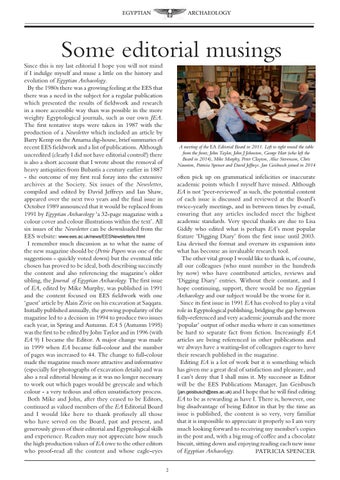
A meeting of the EA Editorial Board in 2011. Left to right round the table from the front; John Taylor, John J Johnston, George Hart (who left the Board in 2014), Mike Murphy, Peter Clayton, Alice Stevenson, Chris Naunton, Patricia Spencer and David Jeffreys. Jan Geisbusch joined in 2014
often pick up on grammatical infelicities or inaccurate academic points which I myself have missed. Although EA is not ‘peer-reviewed’ as such, the potential content of each issue is discussed and reviewed at the Board’s twice-yearly meetings, and in between times by e-mail, ensuring that any articles included meet the highest academic standards. Very special thanks are due to Lisa Giddy who edited what is perhaps EA’s most popular feature ‘Digging Diary’ from the first issue until 2003. Lisa devised the format and oversaw its expansion into what has become an invaluable research tool. The other vital group I would like to thank is, of course, all our colleagues (who must number in the hundreds by now) who have contributed articles, reviews and ‘Digging Diary’ entries. Without their constant, and I hope continuing, support, there would be no Egyptian Archaeology and our subject would be the worse for it. Since its first issue in 1991 EA has evolved to play a vital role in Egyptological publishing, bridging the gap between fully-referenced and very academic journals and the more ‘popular’ output of other media where it can sometimes be hard to separate fact from fiction. Increasingly EA articles are being referenced in other publications and we always have a waiting-list of colleagues eager to have their research published in the magazine. Editing EA is a lot of work but it is something which has given me a great deal of satisfaction and pleasure, and I can’t deny that I shall miss it. My successor as Editor will be the EES Publications Manager, Jan Geisbusch (jan.geisbusch@ees.ac.uk) and I hope that he will find editing EA to be as rewarding as have I. There is, however, one big disadvantage of being Editor in that by the time an issue is published, the content is so very, very familiar that it is impossible to appreciate it properly so I am very much looking forward to receiving my member’s copies in the post and, with a big mug of coffee and a chocolate biscuit, sitting down and enjoying reading each new issue of Egyptian Archaeology. PATRICIA SPENCER