EGYPTIAN
ARCHAEOLOGY
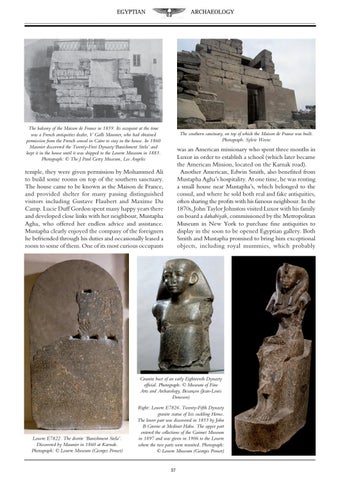
The balcony of the Maison de France in 1859. Its occupant at the time was a French antiquities dealer, V Galli Maunier, who had obtained permission from the French consul in Cairo to stay in the house. In 1860 Maunier discovered the Twenty-First Dynasty‘Banishment Stela’ and kept it in the house until it was shipped to the Louvre Museum in 1883. Photograph: © The J Paul Getty Museum, Los Angeles
The southern sanctuary, on top of which the Maison de France was built. Photograph: Sylvie Weens
was an American missionary who spent three months in Luxor in order to establish a school (which later became the American Mission, located on the Karnak road). Another American, Edwin Smith, also benefited from Mustapha Agha’s hospitality. At one time, he was renting a small house near Mustapha’s, which belonged to the consul, and where he sold both real and fake antiquities, often sharing the profits with his famous neighbour. In the 1870s, John Taylor Johnston visited Luxor with his family on board a dahabiyah, commissioned by the Metropolitan Museum in New York to purchase fine antiquities to display in the soon to be opened Egyptian gallery. Both Smith and Mustapha promised to bring him exceptional objects, including royal mummies, which probably
temple, they were given permission by Mohammed Ali to build some rooms on top of the southern sanctuary. The house came to be known as the Maison de France, and provided shelter for many passing distinguished visitors including Gustave Flaubert and Maxime Du Camp. Lucie Duff Gordon spent many happy years there and developed close links with her neighbour, Mustapha Agha, who offered her endless advice and assistance. Mustapha clearly enjoyed the company of the foreigners he befriended through his duties and occasionally leased a room to some of them. One of its most curious occupants
Granite bust of an early Eighteenth Dynasty official. Photograph: © Museum of Fine Arts and Archaeology, Besançon (Jean-Louis Dousson)
Louvre E7822. The diorite ‘Banishment Stela’. Discovered by Maunier in 1860 at Karnak. Photograph: © Louvre Museum (Georges Poncet)
Right: Louvre E7826. Twenty-Fifth Dynasty granite statue of Isis suckling Horus. The lower part was discovered in 1855 by John B Greene at Medinet Habu. The upper part entered the collections of the Guimet Museum in 1897 and was given in 1906 to the Louvre where the two parts were reunited. Photograph: © Louvre Museum (Georges Poncet) 37