EGYPTIAN
ARCHAEOLOGY
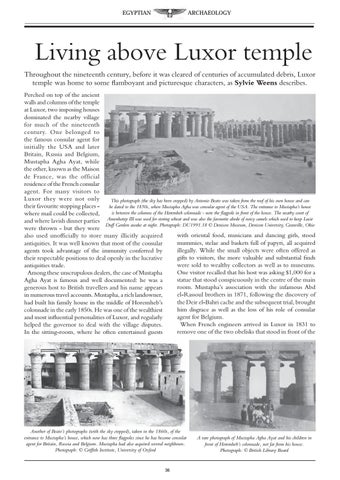
Living above Luxor temple Throughout the nineteenth century, before it was cleared of centuries of accumulated debris, Luxor temple was home to some flamboyant and picturesque characters, as Sylvie Weens describes. Perched on top of the ancient walls and columns of the temple at Luxor, two imposing houses dominated the nearby village for much of the nineteenth century. One belonged to the famous consular agent for initially the USA and later Britain, Russia and Belgium, Mustapha Agha Ayat, while the other, known as the Maison de France, was the official residence of the French consular agent. For many visitors to Luxor they were not only This photograph (the sky has been cropped) by Antonio Beato was taken from the roof of his own house and can their favourite stopping places - be dated to the 1850s, when Mustapha Agha was consular agent of the USA. The entrance to Mustapha’s house is between the columns of the Horemheb colonnade - note the flagpole in front of the house. The nearby court of where mail could be collected, and where lavish dinner parties Amenhotep III was used for storing wheat and was also the favourite abode of noisy camels which used to keep Lucie Duff Gordon awake at night. Photograph: DU1991.18 © Denison Museum, Denison University, Granville, Ohio were thrown - but they were with oriental food, musicians and dancing girls, stood also used unofficially to store many illicitly acquired mummies, stelae and baskets full of papyri, all acquired antiquities. It was well known that most of the consular illegally. While the small objects were often offered as agents took advantage of the immunity conferred by gifts to visitors, the more valuable and substantial finds their respectable positions to deal openly in the lucrative were sold to wealthy collectors as well as to museums. antiquities trade. One visitor recalled that his host was asking $1,000 for a Among these unscrupulous dealers, the case of Mustapha statue that stood conspicuously in the centre of the main Agha Ayat is famous and well documented: he was a room. Mustapha’s association with the infamous Abd generous host to British travellers and his name appears el-Rassoul brothers in 1871, following the discovery of in numerous travel accounts. Mustapha, a rich landowner, the Deir el-Bahri cache and the subsequent trial, brought had built his family house in the middle of Horemheb’s him disgrace as well as the loss of his role of consular colonnade in the early 1850s. He was one of the wealthiest agent for Belgium. and most influential personalities of Luxor, and regularly When French engineers arrived in Luxor in 1831 to helped the governor to deal with the village disputes. remove one of the two obelisks that stood in front of the In the sitting-room, where he often entertained guests
Another of Beato’s photographs (with the sky cropped), taken in the 1860s, of the entrance to Mustapha’s house, which now has three flagpoles since he has become consular agent for Britain, Russia and Belgium. Mustapha had also acquired several neighbours. Photograph: © Griffith Institute, University of Oxford
36
A rare photograph of Mustapha Agha Ayat and his children in front of Horemheb’s colonnade, not far from his house. Photograph: © British Library Board