EGYPTIAN
ARCHAEOLOGY
These surprising results lead us to the continuing debate as to whether Perunefer was in Memphis or at Tell el-Daba in the Delta. A major reason put forward for identifying Tell el-Daba with Perunefer is that a harbour for large seagoing vessels needs access for shipping throughout the year. Since the seasonal flooding in Egypt allows navigation in Upper Egypt only during the months of the inundation, it has been proposed that a harbour which functioned all year round must have been located in the Delta rather than to the south at Memphis. But is this a valid argument? Is the concept of a permanently active harbour relevant here, or is it perhaps a modern concept imposed on ancient Egypt? Is it not more likely that major trade and military expeditions were undertaken only under ideal climate conditions, at times of the high flood, as is known in the nineteenth century AD before the regulation of the Nile (see Cooper, EA 41, p.26), and at times when the wind conditions in the Mediterranean were favourable to navigation? If so, it is possible that Perunefer could have been situated south of the Nile Delta, and associated with Memphis, the Eighteenth Dynasty royal residence. This would seem to be a more logical choice for Perunefer, the naval base and starting point for the famous military campaigns of the earlier New Kingdom. It is hoped that future research on the harbour area at Tell el-Daba will be able to shed more light on this controversial subject.
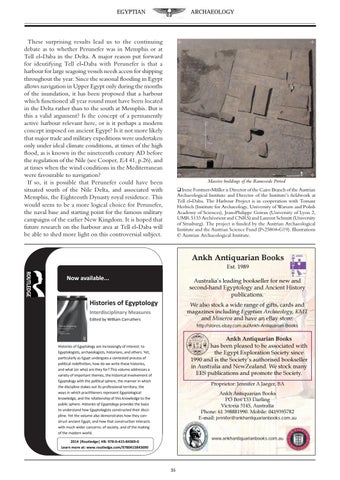
Massive buildings of the Ramesside Period q Irene Forstner-Müller is Director of the Cairo Branch of the Austrian Archaeological Institute and Director of the Institute’s fieldwork at Tell el-Daba. The Harbour Project is in cooperation with Tomasz Herbich (Institute for Archaeology, University of Warsaw and Polish Academy of Sciences), Jean-Philippe Goiran (University of Lyon 2, UMR 5133 Archéorient and CNRS) and Laurent Schmitt (University of Strasburg). The project is funded by the Austrian Archaeological Institute and the Austrian Science Fund (P-25804-G19). Illustrations © Austrian Archaeological Institute.
Ankh Antiquarian Books Est. 1989
v
Now available...
Australia’s leading bookseller for new and second-hand Egyptology and Ancient History publications.
Histories of Egyptology
We also stock a wide range of gifts, cards and magazines including Egyptian Archaeology, KMT and Minerva and have an eBay store:
Interdisciplinary Measures Edited by William Carruthers
http://stores.ebay.com.au/Ankh-Antiquarian-Books
Ankh Antiquarian Books has been pleased to be associated with the Egypt Exploration Society since 1990 and is the Society’s authorised bookseller in Australia and NewZealand. We stock many EES publications and promote the Society.
Histories of Egyptology are increasingly of interest: to Egyptologists, archaeologists, historians, and others. Yet, particularly as Egypt undergoes a contested process of political redefinition, how do we write these histories, and what (or who) are they for? This volume addresses a variety of important themes, the historical involvement of Egyptology with the political sphere, the manner in which the discipline stakes out its professional territory, the ways in which practitioners represent Egyptological knowledge, and the relationship of this knowledge to the public sphere. Histories of Egyptology provides the basis to understand how Egyptologists constructed their discipline. Yet the volume also demonstrates how they construct ancient Egypt, and how that construction interacts with much wider concerns: of society, and of the making of the modern world.
Proprietor: Jennifer A Jaeger, BA Ankh Antiquarian Books PO Box 133 Darling Victoria 3145, Australia Phone: 61 398881990. Mobile: 0419395782 E-mail: jennifer@ankhantiquarianbooks.com.au
www.ankhantiquarianbooks.com.au
2014 |Routledge| HB: 978-0-415-84369-0 Learn more at: www.routledge.com/9780415843690
35