EGYPTIAN
ARCHAEOLOGY
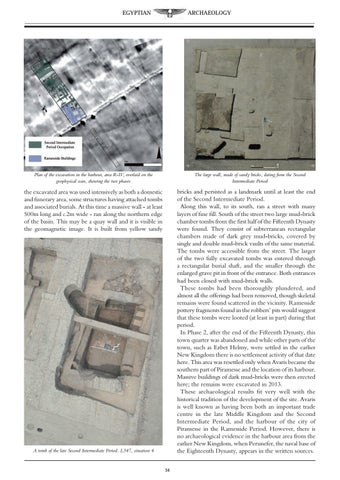
Plan of the excavation in the harbour, area R-IV, overlaid on the geophysical scan, showing the two phases
The large wall, made of sandy bricks, dating from the Second Intermediate Period
bricks and persisted as a landmark until at least the end of the Second Intermediate Period. Along this wall, to its south, ran a street with many layers of fine fill. South of the street two large mud-brick chamber tombs from the first half of the Fifteenth Dynasty were found. They consist of subterranean rectangular chambers made of dark grey mud-bricks, covered by single and double mud-brick vaults of the same material. The tombs were accessible from the street. The larger of the two fully excavated tombs was entered through a rectangular burial shaft, and the smaller through the enlarged grave pit in front of the entrance. Both entrances had been closed with mud-brick walls. These tombs had been thoroughly plundered, and almost all the offerings had been removed, though skeletal remains were found scattered in the vicinity. Ramesside pottery fragments found in the robbers’ pits would suggest that these tombs were looted (at least in part) during that period. In Phase 2, after the end of the Fifteenth Dynasty, this town quarter was abandoned and while other parts of the town, such as Ezbet Helmy, were settled in the earlier New Kingdom there is no settlement activity of that date here. This area was resettled only when Avaris became the southern part of Piramesse and the location of its harbour. Massive buildings of dark mud-bricks were then erected here; the remains were excavated in 2013. These archaeological results fit very well with the historical tradition of the development of the site. Avaris is well known as having been both an important trade centre in the late Middle Kingdom and the Second Intermediate Period, and the harbour of the city of Piramesse in the Ramesside Period. However, there is no archaeological evidence in the harbour area from the earlier New Kingdom, when Perunefer, the naval base of the Eighteenth Dynasty, appears in the written sources.
the excavated area was used intensively as both a domestic and funerary area, some structures having attached tombs and associated burials. At this time a massive wall - at least 500m long and c.2m wide - ran along the northern edge of the basin. This may be a quay wall and it is visible in the geomagnetic image. It is built from yellow sandy
A tomb of the late Second Intermediate Period. L347, situation 4 34