EGYPTIAN
ARCHAEOLOGY
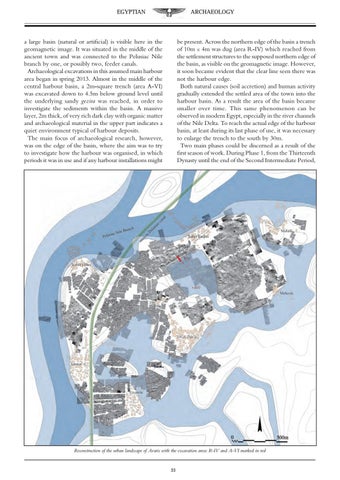
a large basin (natural or artificial) is visible here in the geomagnetic image. It was situated in the middle of the ancient town and was connected to the Pelusiac Nile branch by one, or possibly two, feeder canals. Archaeological excavations in this assumed main harbour area began in spring 2013. Almost in the middle of the central harbour basin, a 2m-square trench (area A-VI) was excavated down to 4.5m below ground level until the underlying sandy gezira was reached, in order to investigate the sediments within the basin. A massive layer, 2m thick, of very rich dark clay with organic matter and archaeological material in the upper part indicates a quiet environment typical of harbour deposits. The main focus of archaeological research, however, was on the edge of the basin, where the aim was to try to investigate how the harbour was organised, in which periods it was in use and if any harbour installations might
be present. Across the northern edge of the basin a trench of 10m x 4m was dug (area R-IV) which reached from the settlement structures to the supposed northern edge of the basin, as visible on the geomagnetic image. However, it soon became evident that the clear line seen there was not the harbour edge. Both natural causes (soil accretion) and human activity gradually extended the settled area of the town into the harbour basin. As a result the area of the basin became smaller over time. This same phenomenon can be observed in modern Egypt, especially in the river channels of the Nile Delta. To reach the actual edge of the harbour basin, at least during its last phase of use, it was necessary to enlarge the trench to the south by 30m. Two main phases could be discerned as a result of the first season of work. During Phase 1, from the Thirteenth Dynasty until the end of the Second Intermediate Period,
Reconstruction of the urban landscape of Avaris with the excavation areas R-IV and A-VI marked in red 33