EGYPTIAN
ARCHAEOLOGY
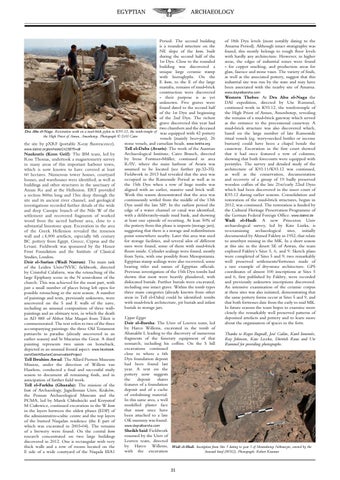
Period. The second building of 18th Dyn levels (most notably dating to the is a rounded structure on the Amarna Period). Although intact stratigraphy was NE slope of the kom, built found, this mostly belongs to rough floor levels during the second half of the with hardly any architecture. However, in higher 1st Dyn. Close to the rounded areas, the edges of industrial zones were found building was discovered a - for copper smelting, and production areas for unique large ceramic stamp glass, faience and stone vases. The variety of finds, with hieroglyphs. On the as well as the associated pottery, suggest that this E kom, to the E of the large industrial site was run by the state and may have mastaba, remains of mud-brick been associated with the nearby site of Amarna. construction were discovered www.dayralbarsha.com - their purpose is as yet Western Thebes: At Dra Abu el-Naga the unknown. Five graves were DAI expedition, directed by Ute Rummel, found dated to the second half continued work in K93.12, the tomb-temple of of the 1st Dyn and beginning the High Priest of Amun, Amenhotep, revealing of the 2nd Dyn. The richest the remains of a mud-brick gateway which served grave discovered this year had as the entrance to the processional causeway. A two chambers and the deceased mud-brick structure was also discovered which, Dra Abu el-Naga. Restoration work on a mud-brick pylon in K93.12, the tomb-temple of was equipped with 42 pottery based on the large number of late Ramesside the High Priest of Amun, Amenhotep. Photograph © DAI Cairo vessels (mainly beer-jars), 26 ritual vessels (eg. wavy-necked bottles or incense stone vessels, and carnelian beads. www.farkha.org burners) could have been a chapel beside the the site by pXRF (portable X-ray fluorescence). Tell el-Daba (Avaris): The work of the Austrian causeway. Excavation in the first court showed www.dainst.org/en/node/24238?ft=all Archaeological Institute, Cairo Branch, directed that it had once featured a row of columns, Naukratis (Kom Geif): The BM team, led by by Irene Forstner-Müller, continued in area showing that both forecourts were equipped with Ross Thomas, undertook a magnetometry survey R/IV, where the main harbour of Avaris was peristyles. The survey and detailed study of the in many areas of this important harbour town, assumed to be located (see further pp.32-35). architecture of K93.11/K93.12 was continued, which is now known to have covered at least Fieldwork in 2013 had revealed that the area was as well as the conservation, documentation 60 hectares. Numerous tower houses, courtyard occupied in the Ramesside Period as well as in and recovery of a group of 19 badly preserved houses, and warehouses were identified, as well as the 15th Dyn when a row of huge tombs was wooden coffins of the late 21st/early 22nd Dyns buildings and other structures in the sanctuary of aligned with an earlier, massive sand brick wall. which had been discovered in the inner court of Amun Re and at the Hellenion. ERT provided Work this season demonstrated that the area was K93.12 during earlier seasons. Consolidation and a section 860m long and 15m deep through the continuously settled from the middle of the 13th restoration of the mud-brick structures, begun in site and its ancient river channel, and geological Dyn until the late SIP. In the earliest period the 2012, was continued. The restoration is funded by investigations recorded further details of the wide edge of a water channel or canal was identified, the Cultural Heritage Preservation Programme of and deep Canopic branch of the Nile W of the with a deliberately-made mud bank, and showing the German Federal Foreign Office. www.dainst.de settlement and recovered fragments of worked at least one episode of recutting. At least 50% of Wadi el-Hudi: A new Princeton Univ wood from the sacred harbour area, close to a the pottery from this phase is imports (storage jars), archaeological survey, led by Kate Liszka, is substantial limestone quay. Excavation in the area suggesting that there is a storage and redistribution re-examining archaeological sites, initially of the Greek Hellenion revealed the temenos point somewhere nearby. Later this area was used documented by Ahmed Fakhry in 1952, that relate wall and c.4,000 artefacts, especially 6th century for storage facilities, and several silos of different to amethyst mining in the MK. In a short season BC pottery from Egypt, Greece, Cyprus and the sizes were found, some of them with mud-brick at this site in the desert SE of Aswan, the team Levant. Fieldwork was sponsored by the Honor floors inside. Cylinder sealings were found, mostly explored Fakhry’s Sites 5, 6, and 9. Sketch plans Frost Foundation and the Institute of Classical from Syria, with one possibly from Mesopotamia. were completed of Sites 5 and 9; two remarkably Studies, London. Egyptian stamp sealings were also recovered, some well preserved settlements/fortresses made of Deir el-Surian (Wadi Natrun): The main task bearing titles and names of Egyptian officials. a rare example of dry-stone architecture. GPS of the Leiden Univ/NVIC fieldwork, directed Previous investigation of the 15th Dyn tombs had coordinates of almost 100 inscriptions at Sites 5 by Cristobal Calaforra, was the retouching of the shown that most were heavily plundered, with and 6, first published by Fakhry, were recorded large Epiphany scene in the N semi-dome of the dislocated burials. Further burials were excavated, and previously unknown inscriptions discovered. church. This was achieved for the most part, with including one intact grave. Within the tomb types An intensive examination of the ceramic corpus just a small number of places being left open for three main categories (already known from other at these sites was also initiated, demonstrating that possible retouching in the next season. A number areas in Tell el-Daba) could be identified: tombs the same pottery forms occur at Sites 5 and 9, and of paintings and texts, previously unknown, were with mud-brick architecture, pit burials and infant that both fortresses date from the early to mid MK. uncovered on the S and E walls of the nave, burials in storage jars. In future seasons the team hopes to examine more including an unusual composition of three wallclosely the remarkably well preserved patterns of paintings and an obituary text, in which the death Upper Egypt deposited artefacts and pottery and to learn more in AD 888 of Abbot Mar Maqari from Tikrit is Deir el-Barsha: The Univ of Leuven team, led about the organisation of spaces in the forts. commemorated. The text refers to two of the three by Harco Willems, excavated in the tomb of accompanying paintings: the three Old Testament Ahanakht I, leading to the discovery of numerous patriarchs in paradise (already uncovered in an Thanks to Roger Bagnall, José Galàn, Karel Innemée, fragments of the funerary equipment of that earlier season) and St Macarius the Great. A third Ray Johnson, Kate Liszka, Dietrich Raue and Ute nomarch, including his coffins. On the S hill painting represents two saints on horseback, Rummel for providing photographs. excavations continued depicted in an unusual frontal aspect. www.facebook. close to where a 6th com/DeirAlSurianConservationProject Dyn foundation deposit Tell Ibrahim Awad: The Allard Pierson Museum had been found last Mission, under the direction of Willem van year. A text on the Haarlem, conducted a final and successful study pottery now suggests season to document all remaining finds, and in the deposit shares anticipation of further field work. features of a foundation Tell el-Farkha (Ghazala): The mission of the deposit and of a cache Inst of Archaeology, Jagiellonian Univ, Kraków, of embalming material. the Poznan Archaeological Museum and the In this same area, a well PCMA, led by Marek Chłodnicki and Krzysztof modelled plaster face M Ciałowicz, continued excavation in the W kom that must once have in the layers between the oldest phases (EDP) of been attached to a late the administrative-cultic centre and the top layers OK mummy was found. of the burned Naqadan residence (the E part of www.dayralbarsha.com which was excavated in 2003-04). The remains Sheikh Said: Fieldwork of a brewery were found. On the central kom resumed by the Univ of research concentrated on two large buildings Leuven team, directed discovered in 2012. One is rectangular with very by Harco Willems, Wadi el-Hudi. Inscription from Site 5 dating to year 1 of Montuhotep Nebtawyre, erected by the thick walls and a row of rooms located on the with the excavation Steward Intef (WH2). Photograph: Robert Kraemer E side of a wide courtyard of the Naqada IIIA1
31