EGYPTIAN
Elkab: The BM Expedition, under the direction of Vivian Davies, continued the programme of planning and recording in the main necropolis. In the tomb of Ahmose-Pennekhbet, debris was cleared away to reveal a section of the ancient floor. The original chisel-marks are present, together with remnants of thin white plaster. Within the debris further fragments were found of relief decoration from the doorway. To the S, planning took place of the tomb of Tientis, which has an external stela but no internal decoration. The neighbouring tomb was also accessed and found, unexpectedly, to contain the remnants of four seated figures (two male and two female) on its rear wall, and the remnants of painted decoration on its E and N walls. In the tomb of Senwosret, copying was undertaken of a large finely painted scene on the W wall depicting seated figures of the tomb-owner and his wife. Also copied was a scene on a loose block detached from the E wall, showing part of a hunting scene featuring a lion, a hare and several other quadrupeds. Elsewhere, a much-faded inscription, painted on the lintel of a half-buried (probably late OK) tomb, was copied. Hagr Edfu: The BM team, led by Vivian Davies, undertook a brief study season to check drawings, especially in tomb 3, which has complex secondary decoration, including hieratic visitor-inscriptions. Documentation continued of Coptic ostraca from the site, now stored in the magazine at Elkab. Hierakonpolis: The BM excavations, directed by Renée Friedman, continued at HK6, the elite predynastic cemetery, resulting in the discovery of two further tombs (Nos.72-73); both can be dated to the Naqada IIAB period, and were surrounded by wooden superstructures. Tomb 72 was nearly intact and contained a complete ivory statuette (32cm high), ten ivory combs, two hard-stone palettes, two grinding stones and numerous flint items. Several clay statuettes were found in conjunction with tomb 73. Evidence of 1st Dyn restoration of the structure around tomb 72 indicates the respect paid to deceased ancestors buried in the HK6 cemetery. At HK11C, excavation by Masahiro Baba (Waseda Univ) within a predynastic mud-brick structure, revealed several cooking hearths and animal bones, especially of large fish. These finds indicate that the structure was associated with food production on an industrial scale. At HK27C, the cemetery of the Nubian C-Group, areas only partly excavated in previous seasons were cleared to improve the map for the final publication. This work resulted in the discovery of four new tombs, one containing the naturally mummified body of a woman wearing a leather skirt. www.hierakonpolis-online.org Berenike: The expedition of the Univ of Delaware and the PCMA, led by Steven Sidebotham and Iwona Zych, concentrated on an early Roman-era animal cemetery (cats, dogs, monkeys and a baboon), the early Roman rubbish dump and the SW harbour where parts of a Roman-era ship frame made of cedar wood and a ring intaglio depicting a man on horseback, among other objects, were found. Portions of the early Ptolemaic city wall were also documented. A continuing geophysical project for mapping the entire site with the magnetic method was completed this season. Excavations at the Bronze Age cattle cemetery in Wadi Khashab continued, as did brief surveys of Ptolemaic and Roman sites in the Eastern Desert. Kom Ombo to Aswan: The Aswan-Kom Ombo Archaeological Project (Yale Univ and Univ of Bologna), directed by Maria C Gatto, undertook a survey in the Wadi Kubbaniya and a section of the desert E of Kom Ombo. Particular attention was given to the investigation of stone structures, some of which had already been plundered. Excavations revealed that some were devoid of any human remains, while others were graves. Two of the
ARCHAEOLOGY
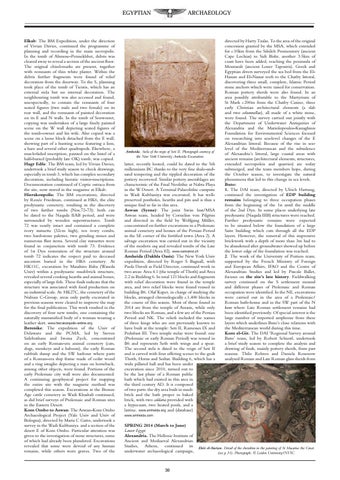
Amheida. Stela of the reign of Seti II. Photograph courtesy of the New York University Amheida Excavation
latter, recently looted, could be dated to the 5th millennium BC thanks to the very fine shale-andsand tempering and the rippled decoration of the pottery recovered. Similar pottery assemblages are characteristic of the Final Neolithic at Nabta Playa in the W Desert. A Terminal Palaeolithic campsite in Wadi Kubbaniya was excavated. It has wellpreserved postholes, hearths and pits and is thus a unique find so far in this area. Aswan (Syene): The joint Swiss Inst/MSA Aswan team, headed by Cornelius von Pilgrim and directed in the field by Wolfgang Müller, concentrated on further excavations in a Ptolemaic animal cemetery and houses of the Persian Period in the SE corner of the fortified town (Area 2). A salvage excavation was carried out in the vicinity of the modern suq and revealed tombs of the Late Roman Period (Area 82). www.swissinst.ch Amheida (Dakhla Oasis): The New York Univ expedition, directed by Roger S Bagnall, with Paola Davoli as Field Director, continued work in two areas: Area 4.1 (the temple of Thoth) and Area 2.2 in Building 6. In total 121 blocks and fragments with relief decoration were found in the temple area, and two relief blocks were found reused in building B6. Olaf Kaper, in charge of studying the blocks, arranged chronologically c.1,400 blocks in the course of this season. Most of those found in 2014 are from the temple of Amasis, while only two blocks are Roman, and a few are of the Persian Period and NK. The reliefs included the names of three kings who are not previously known to have built at the temple: Seti II, Ramesses IX and Pedubast III. Two temple stelae were found: one (Ptolemaic or early Roman Period) was reused in B6 and represents Seth with wings and a spear. The second stela is dated to the reign of Seti II and is carved with four offering scenes to the gods Thoth, Horus and Seshat. Building 6, which has a wide pillared hall and has been under excavation since 2010, turned out to be the last phase of a Roman public bath which had existed in this area in the third century AD. It is composed of two parts: the dry area built in mudbrick and the bath proper in baked brick, with two caldaria provided with a hypocaust, two heated pools, and a latrine. www.amheida.org and (database)
directed by Harry Tzalas. To the area of the original concession granted by the MSA, which extended for c.10km from the Silsileh Promontory (ancient Cape Lochias) to Sidi Bishr, another 3.5km of coast have been added, reaching the peninsula of Montazah (ancient Lesser Taposiris). Greek and Egyptian divers surveyed the sea bed from the ElHassan and El-Nassar reefs to the Chatby littoral, discovering three small, complete, Islamic Period stone anchors which were raised for conservation. Roman pottery sherds were also found. In an area possibly attributable to the Martyrium of St Mark c.200m from the Chatby Casino, three early Christian architectural elements (a slab and two columnellae), all made of a white stone, were found. The survey carried out jointly with the Department of Underwater Antiquities of Alexandria and the Mariolopoulos-Kanaghinis Foundation for Environmental Sciences focused on researching into sea-level changes of the E Alexandrian littoral. Because of the rise in sealevel of the Mediterranean and the subsidence of Alexandria’s littoral, large coastal areas with ancient remains (architectural elements, structures, extended necropoleis and quarries) are today submerged, and the team members hope, during the October season, to investigate the natural phenomena that led to this change in sea levels. Buto: 1. The DAI team, directed by Ulrich Hartung, continued the investigation of EDP building remains belonging to three occupation phases from the beginning of the 1st until the middle of the 2nd Dyn. In some places underlying late predynastic (Naqada IIIB) structures were reached. Further predynastic remains were expected to be situated below the foundation of a large Saite building which cuts through all the EDP layers. However, the removal of this impressive brickwork with a depth of more than 3m had to be abandoned after groundwater showed up before the lower edge of the foundation was reached. 2. The work of the University of Poitiers team, supported by the French Ministry of Foreign and European Affairs, IFAO and the Centre of Alexandrian Studies and led by Pascale Ballet, focuses on the site’s late history. Fieldwalking survey continued on the S settlement mound and different phases of Ptolemaic and Roman occupation were identified. In the NE, excavations were carried out in the area of a Ptolemaic/ Roman bath-house and in the SW part of the N kom where Late Roman settlement remains had been identified previously. Of special interest is the large number of imported amphorae from these layers which underlines Buto’s close relations with the Mediterranean world during this time. Kom el-Gir. The DAI ‘Regional Survey around Buto’ team, led by Robert Schiestl, undertook a brief study season to complete the analysis and drawing of finds, mainly pottery sherds, from past seasons. Thilo Rehren and Daniela Rosenow analysed Roman and Late Roman glass sherds from
www.amheida.com
SPRING 2014 (March to June) Lower Egypt Alexandria. The Hellenic Institute of Ancient and Mediaeval Alexandrian Studies, Athens, continued its underwater archaeological campaign,
30
Deir el-Surian. Detail of the cherubim in the painting of St Macarius the Great (see p.31). Photograph: © Leiden University/NVIC