EGYPTIAN
ARCHAEOLOGY
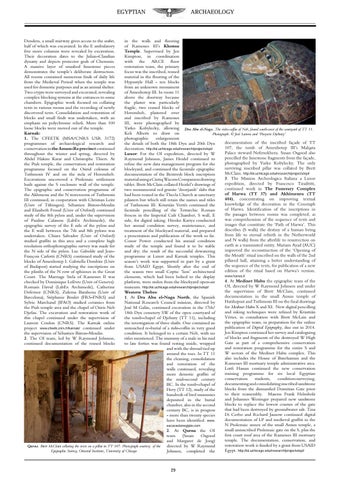
in the walls and flooring of Ramesses III’s Khonsu Temple. Supervised by Jen Kimpton, in coordination with the ARCE floor restoration team, the primary focus was the inscribed, reused material in the flooring of the Hypostyle Hall - ten blocks from an unknown monument of Amenhotep III. In room 11 above the doorway because the plaster was particularly fragile, two reused blocks of Horemheb, plastered over and inscribed by Ramesses III, were photographed by Yarko Kobylecky, allowing Dra Abu el-Naga. The rishi-coffin of Neb, found south-west of the courtyard of TT 11. Keli Alberts to draw on Photograph: © José Latova and ‘Proyecto Djehuty’ photographic enlargements documentation of the inscribed façade of TT the details of both the 18th Dyn and 20th Dyn 107, the tomb of Amenhotep III’s Malqata decoration. http://oi.uchicago.edu/research/projects/epi/ Palace steward Nefersekheru. Susan Osgood also Luxor: For the OI expedition, directed by W pencilled the limestone fragments from the façade, Raymond Johnson, James Heidel continued to photographed by Yarko Kobylecky. The only refine the new data management program for the surviving inscribed pillar was collated by Brett blockyard, and continued the facsimile epigraphic McClain. http://oi.uchicago.edu/research/projects/epi/ documentation of the Bentresh block inscription 3. The Mission Archeologica Italiana a Luxor material using a Cintiq Wacom Companion drawing expedition, directed by Francesco Tiradritti, tablet. Brett McClain collated Heidel’s drawings of continued work in The Funerary Complex two monumental red granite ‘doorjamb’ slabs that of Harwa (TT 37) and Akhimenru (TT had been reused in the Thecla Church as sanctuary 404), concentrating on improving textual pilasters but which still retain the names and titles knowledge of the decoration in the Cenotaph of Tuthmosis III. Krisztián Vertés continued the of Harwa. Identification of the inscriptions in facsimile pencilling of the Tetrarchic Roman the passages between rooms was completed, as frescos in the Imperial Cult Chamber, S wall, E was comprehension of the sequence of texts and side, for digital inking. Hiroko Kariya conducted images that constitute the ‘Path of Harwa’. This her annual condition survey, maintenance, and describes (S walls) the destiny of a human being treatment of the blockyard material, and prepared from life to eternal rebirth in the Netherworld a presentation and publication of the work so far. and N walls) from the afterlife to resurrection on Conor Power conducted his annual condition earth as a transmuted entity. Mariam Ayad (AUC) study of the temple and found it to be stable improved the reconstruction of the ‘Opening of and dry; the result of the successful dewatering the Mouth’ ritual inscribed on the walls of the 2nd programme at Luxor and Karnak temples. This pillared hall, attaining a better understanding of season’s work was supported in part by a grant the sequence of the texts, for publication of a new from USAID Egypt. Shortly after the end of edition of the ritual based on Harwa’s version. the season two small Coptic ‘lion’ architectural www.harwa.it elements, which had been bolted to the display 4. At Medinet Habu the epigraphic team of the platform, were stolen from the blockyard open-air OI, directed by W Raymond Johnson and under museum. http://oi.uchicago.edu/research/projects/epi/ the supervision of Brett McClain, continued Western Thebes: documentation in the small Amun temple of 1. At Dra Abu el-Naga North, the Spanish Hatshepsut and Tuthmosis III on the final drawings National Research Council mission, directed by for Medinet Habu X and XI. New digital pencilling José M Galàn, continued excavation in the 17th/ and inking techniques were refined by Krisztián 18th Dyn cemetery SW of the open courtyard of Vértes, in consultation with Brett McLain and the tomb-chapel of Djehuty (TT 11), including the epigraphic team, in preparation for the online the investigation of three shafts. One contained an publication of Digital Epigraphy, due out in 2014. untouched re-burial of a rishi-coffin in very good Jen Kimpton continued her survey and cataloguing condition. It belonged to a certain Neb, with no of blocks and fragments of the destroyed W High titles mentioned. The mummy of a male in his mid Gate as part of a comprehensive conservation to late forties was found resting inside, wrapped and restoration programme for the entire S and and with the shroud tied up W sectors of the Medinet Habu complex. This around the toes. In TT 11 also includes the House of Butehamun and the the cleaning, consolidation Ramesses III mortuary temple administrative area. and restoration of the Lotfi Hassan continued the new conservation walls continued, revealing training programme for six local Egyptian more demotic graffiti of conservation students, condition-surveying, the mid-second century documenting and consolidating inscribed sandstone BC. In the tomb-chapel of blocks from the dismantled Domitian Gate prior Hery (TT 12), study of the to their reassembly. Masons Frank Helmholz hundreds of bird mummies and Johannes Weninger prepared new sandstone deposited in the burial blocks to replace the lowest courses of the gate chamber, also in the second that had been destroyed by groundwater salt. Tina century BC, is in progress Di Cerbo and Richard Jasnow continued digital - more than twenty species documentation of LP and medieval graffiti in the have been identified. www. N Ptolemaic annex of the small Amun temple, a excavacionegipto.com small uninscribed Ptolemaic gate on the S, plus the 2. At Qurna the OI first court roof area of the Ramesses III mortuary team (Susan Osgood temple. The documentation, conservation, and and Margaret de Jong) restoration work is funded by a grant from USAID Qurna. Brett McClain collating the texts on a pillar in TT 107. Photograph courtesy of the directed by W Raymond Egypt. http://oi.uchicago.edu/research/projects/epi/ Epigraphic Survey, Oriental Institute, University of Chicago Johnson, completed the
Dendera, a small stairway gives access to the wabet, half of which was excavated. In the E ambulatory five more columns were revealed by excavation. Their decoration dates to the Julian-Claudian dynasty and depicts protector gods of Chemmis. A massive layer of smashed limestone pieces demonstrates the temple’s deliberate destruction. All rooms contained numerous finds of daily life from the Medieval Period when the temple was used for domestic purposes and as an animal shelter. Two crypts were surveyed and excavated, revealing complex blocking systems at the entrances to some chambers. Epigraphic work focused on collating texts in various rooms and the recording of newly discovered texts. Consolidation and restoration of blocks and small finds was undertaken, with an emphasis on polychrome reliefs. More than 100 loose blocks were moved out of the temple. Karnak: 1. The CFEETK (MSA/CNRS USR 3172) programmes of archaeological research and conservation in the Amun-Re precinct continued throughout the winter and spring, directed by Abdel Hakim Karar and Christophe Thiers. At the Ptah temple, the conservation and restoration programme focused on the Osirid colossus of Tuthmosis IV and on the stela of Horemheb. Excavations uncovered a Ptolemaic settlement built against the S enclosure wall of the temple. The epigraphic and conservation programme of the Akhmenu and the N storerooms of Tuthmosis III continued, in cooperation with Christian Leitz (Univ of Tübingen). Sébastien Biston-Moulin and Elizabeth Frood (Univ of Oxford) continued study of the 8th pylon and, under the supervision of Pauline Calassou (LabEx Archimede), the epigraphic survey of the E side of the pylon and the E wall between the 7th and 8th pylons was undertaken. Chiara Salvador (Univ of Oxford) studied graffiti in this area and a complete high resolution orthophotographic survey was made for the N side of the pylon. Luc Gabolde and JeanFrançois Carlotti (CNRS) continued study of the blocks of Amenhotep I. Gabriella Dembitz (Univ of Budapest) started studying the inscriptions on the plinths of the N row of sphinxes in the Great Court. The Marriage Stela of Ramesses II was checked by Dominique Lefèvre (Univ of Geneva). Romain David (LabEx Archimede), Catherine Defernez (CNRS), Zulema Barahona (Univ of Barcelona), Stéphanie Boulet (FRS-FNRS) and Sylvie Marchand (IFAO) studied ceramics from the Ptah temple area and the chapel of Osiris Neb Djefau. The excavation and restoration work of this chapel continued under the supervision of Laurent Coulon (CNRS). The Karnak online project www.cfeetk.cnrs.fr/karnak/ continued under the supervision of Sébastien Biston-Moulin. 2. The OI team, led by W Raymond Johnson, continued documentation of the reused blocks
29