EGYPTIAN
ARCHAEOLOGY
Digging Diary 2013-14 Summaries of some of the archaeological work undertaken in Egypt in Winter 2013-14 and Spring 2014 appear below. The sites are arranged geographically from north to south, ending with the oases. Field Directors who would like reports on their work to appear in EA are asked to e-mail a short summary, with a website address if available, as soon as possible after the end of each season to: jan.geisbusch@ees.ac.uk PATRICIA SPENCER Abbreviations: EDP Early Dynastic Period; OK Old Kingdom; FIP First Intermediate Period; MK Middle Kingdom; SIP Second Intermediate Period; NK New Kingdom; TIP Third Intermediate Period; LP Late Period; GR Graeco-Roman; ERT Electrical Resistance Tomography. Institutes and Research Centres: ARCE American Research Center in Egypt; AUC American University, Cairo; BA British Academy; BM British Museum; CFEETK Franco-Egyptian Centre, Karnak; CNRS French National Research Centre; DAI German Institute, Cairo; FNRS National Fund for Scientific Research, Brussels; IFAO French Institute, Cairo; MSA Ministry of State for Antiquities, Egypt; NVIC NetherlandsFlemish Institute, Cairo; OI Oriental Institute, University of Chicago; PCMA Polish Centre for Mediterranean Archaeology, Warsaw; Swiss Inst Swiss Institute for Architectural Research and Archaeology, Cairo; USR CNRS research group. WINTER 2013-14 (November to March) Lower Egypt Matariya/Heliopolis: The joint excavation of the MSA and the Egyptian Museum Georg Steindorff, Univ of Leipzig, directed by Aiman Ashmawy and Dietrich Raue, continued excavations in the temple area. The geophysical and geomorphological survey proved that the
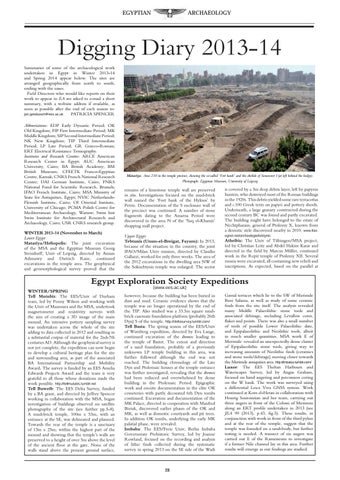
Matariya. Area 210 in the temple precinct, showing the so-called ‘Fort bank’ and the obelisk of Senwosret I (at left behind the hedge). Photograph: Egyptian Museum, University of Leipzig
remains of a limestone temple wall are preserved in situ. Investigations focused on the mud-brick wall named the ‘Fort bank of the Hyksos’ by Petrie. Documentation of the S enclosure wall of the precinct was continued. A number of stone fragments dating to the Amarna Period were discovered in the area N of the ‘Suq el-Khamis’ shopping mall project.
is covered by a 3m deep debris layer, left by papyrus hunters, who destroyed most of the Roman buildings in the 1920s. This debris yielded some rare terracottas and c.100 Greek texts on papyri and pottery sherds. Underneath, a large granary constructed during the second century BC was found and partly excavated. The building might have belonged to the estate of Nechtpharaus, general of Ptolemy X, known from a demotic stele discovered nearby in 2010. www.ifao.
Upper Egypt Tebtunis (Umm-el-Breigat, Fayum): In 2013, because of the situation in the country, the joint IFAO/Milan Univ mission, directed by Claudio Gallazzi, worked for only three weeks. The area of the 2012 excavations in the dwelling area NW of the Soknebtynis temple was enlarged. The sector
egnet.net/archeologie/tebtynis
Athribis: The Univ of Tübingen/MSA project, led by Christian Leitz and Abdel Hakim Karar and directed in the field by Marcus Müller, continued work in the Repit temple of Ptolemy XII. Several rooms were excavated, all containing new reliefs and inscriptions. As expected, based on the parallel at
Egypt Exploration Society Expeditions WINTER/SPRING Tell Mutubis: The EES/Univ of Durham team, led by Penny Wilson and working with the Univ of Mansoura and the MSA, undertook magnetometer and resistivity surveys with the aim of creating a 3D image of the main mound. An intensive pottery sampling survey was undertaken across the whole of the site adding to data collected in 2012 and resulting in a substantial corpus of material for the 2nd-7th centuries AD. Although the geophysical survey is not yet complete, the expedition can now begin to develop a cultural heritage plan for the site and surrounding area, as part of the associated BA International Partnership and Mobility Award. The survey is funded by an EES Amelia Edwards Projects Award and the team is very grateful to all those whose donations made the work possible. http://tellmutubis.tumblr.net Tell Buweib: The EES Delta Survey, funded by a BA grant, and directed by Jeffrey Spencer working in collaboration with the MSA, began investigation of buildings observed on satellite photography of the site (see further pp.5-8). A mud-brick temple, 100m x 53m, with an entrance at the SE, was delineated and planned. Towards the rear of the temple is a sanctuary of 13m x 25m, within the highest part of the mound and showing that the temple’s walls are preserved to a height of over 5m above the level of the ancient floor at the gate. None of the walls stand above the present ground surface,
(www.ees.ac.uk)
however, because the building has been buried in dust and mud. Ceramic evidence shows that the temple was no longer operational by the end of the TIP. Also studied was a 33.5m square mudbrick casemate foundation platform (probably 26th Dyn) S of the temple. http://deltasurvey.tumblr.com/ Tell Basta: The spring season of the EES/Univ of Wurzberg expedition, directed by Eva Lange, continued excavation of the dromos leading to the temple of Bastet. The extent and direction of a sand foundation, probably of a previously unknown LP temple building in this area, was further followed although the end was not reached. The building chronology of the Late Dyn and Ptolemaic houses at the temple entrance was further investigated, revealing that the dromos had been reduced and overwhelmed by dense building in the Ptolemaic Period. Epigraphic work and on-site documentation in the elite OK cemeteries with partly decorated 6th Dyn tombs continued. Excavation and documentation of the MK Palace, directed in cooperation with Manfred Bietak, discovered earlier phases of the OK and MK, as well as domestic courtyards and pit trees. In addition OK tombs, underlying the early MK palatial phase, were revealed. Imbaba: The EES/Freie Univ, Berlin Imbaba Governorate Prehistoric Survey, led by Joanne Rowland, focused on the recording and analysis of lithic finds collected during the systematic survey in spring 2013 on the SE side of the Wadi
28
Gamal terraces which lie to the SW of Merimde Beni Salama, as well as study of some ceramic finds from the site itself. The analysis revealed many Middle Palaeolithic stone tools and associated debitage, including Levallois cores, flakes and points. There was also a small number of tools of possible Lower Palaeolithic date, and Epipalaeolithic and Neolithic tools, albeit in much smaller quantities. MSA work E of Merimde revealed an unexpectedly dense cluster of Epipalaeolithic stone tools, giving way to increasing amounts of Neolithic finds (ceramics and stone tools/debitage) moving closer towards the Merimde antiquities area. http://imbaba.tumblr.com/ Luxor: The EES Theban Harbours and Waterscapes Survey, led by Angus Graham, focused on hand augering and percussion coring on the W bank. The work was surveyed using a differential Leica Viva GNSS system. Work continued at Kom el-Hetan in collaboration with Hourig Sourouzian and her team, carrying out three augers in front of the Colossi of Memnon along an ERT profile undertaken in 2013 (see JEA 99 (2013), p.43, fig.5). These results, in conjunction with work in front of the third pylon and at the rear of the temple, suggest that the temple was founded on a sand-body, but further testing is needed. A transect of six augers was carried out E of the Ramesseum to investigate if a former Nile channel lay in this area. Further results will emerge as our findings are studied.