EGYPTIAN
ARCHAEOLOGY
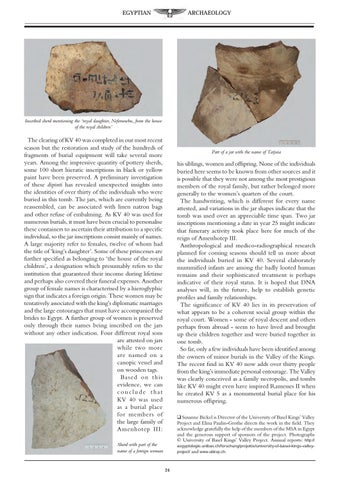
Inscribed sherd mentioning the ‘royal daughter, Neferunebu, from the house of the royal children’
The clearing of KV 40 was completed in our most recent season but the restoration and study of the hundreds of fragments of burial equipment will take several more years. Among the impressive quantity of pottery sherds, some 100 short hieratic inscriptions in black or yellow paint have been preserved. A preliminary investigation of these dipinti has revealed unexpected insights into the identities of over thirty of the individuals who were buried in this tomb. The jars, which are currently being reassembled, can be associated with linen natron bags and other refuse of embalming. As KV 40 was used for numerous burials, it must have been crucial to personalise these containers to ascertain their attribution to a specific individual, so the jar inscriptions consist mainly of names. A large majority refer to females, twelve of whom had the title of ‘king’s daughter’. Some of these princesses are further specified as belonging to ‘the house of the royal children’, a designation which presumably refers to the institution that guaranteed their income during lifetime and perhaps also covered their funeral expenses. Another group of female names is characterised by a hieroglyphic sign that indicates a foreign origin. These women may be tentatively associated with the king’s diplomatic marriages and the large entourages that must have accompanied the brides to Egypt. A further group of women is preserved only through their names being inscribed on the jars without any other indication. Four different royal sons are attested on jars while two more are named on a canopic vessel and on wooden tags. Based on this evidence, we can conclude that KV 40 was used as a burial place for members of the large family of Amenhotep III:
Part of a jar with the name of Tatjuia
his siblings, women and offspring. None of the individuals buried here seems to be known from other sources and it is possible that they were not among the most prestigious members of the royal family, but rather belonged more generally to the women’s quarters of the court. The handwriting, which is different for every name attested, and variations in the jar shapes indicate that the tomb was used over an appreciable time span. Two jar inscriptions mentioning a date in year 25 might indicate that funerary activity took place here for much of the reign of Amenhotep III. Anthropological and medico-radiographical research planned for coming seasons should tell us more about the individuals buried in KV 40. Several elaborately mummified infants are among the badly looted human remains and their sophisticated treatment is perhaps indicative of their royal status. It is hoped that DNA analyses will, in the future, help to establish genetic profiles and family relationships. The significance of KV 40 lies in its preservation of what appears to be a coherent social group within the royal court. Women - some of royal descent and others perhaps from abroad - seem to have lived and brought up their children together and were buried together in one tomb. So far, only a few individuals have been identified among the owners of minor burials in the Valley of the Kings. The recent find in KV 40 now adds over thirty people from the king’s immediate personal entourage. The Valley was clearly conceived as a family necropolis, and tombs like KV 40 might even have inspired Ramesses II when he created KV 5 as a monumental burial place for his numerous offspring. q Susanne Bickel is Director of the University of Basel Kings’ Valley Project and Elina Paulin-Grothe directs the work in the field. They acknowledge gratefully the help of the members of the MSA in Egypt and the generous support of sponsors of the project. Photographs © University of Basel Kings’ Valley Project. Annual reports: http://
Sherd with part of the name of a foreign woman
aegyptologie.unibas.ch/forschung/projekte/university-of-basel-kings-valleyproject/ and www.ubkvp.ch.
24