EGYPTIAN
ARCHAEOLOGY
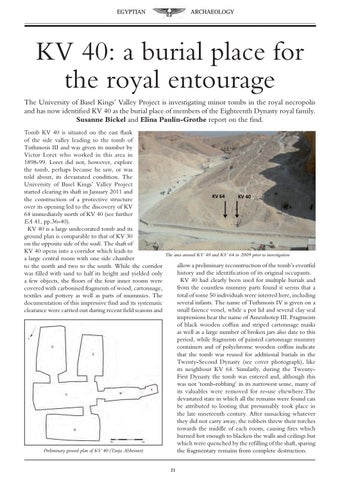
KV 40: a burial place for the royal entourage The University of Basel Kings’ Valley Project is investigating minor tombs in the royal necropolis and has now identified KV 40 as the burial place of members of the Eighteenth Dynasty royal family. Susanne Bickel and Elina Paulin-Grothe report on the find. Tomb KV 40 is situated on the east flank of the side valley leading to the tomb of Tuthmosis III and was given its number by Victor Loret who worked in this area in 1898-99. Loret did not, however, explore the tomb, perhaps because he saw, or was told about, its devastated condition. The University of Basel Kings’ Valley Project started clearing its shaft in January 2011 and the construction of a protective structure over its opening led to the discovery of KV 64 immediately north of KV 40 (see further EA 41, pp.36-40). KV 40 is a large undecorated tomb and its ground plan is comparable to that of KV 30 on the opposite side of the wadi. The shaft of KV 40 opens into a corridor which leads to The area around KV 40 and KV 64 in 2009 prior to investigation a large central room with one side chamber allow a preliminary reconstruction of the tomb’s eventful to the north and two to the south. While the corridor history and the identification of its original occupants. was filled with sand to half its height and yielded only KV 40 had clearly been used for multiple burials and a few objects, the floors of the four inner rooms were from the countless mummy parts found it seems that a covered with carbonised fragments of wood, cartonnage, total of some 50 individuals were interred here, including textiles and pottery as well as parts of mummies. The several infants. The name of Tuthmosis IV is given on a documentation of this impressive find and its systematic small faience vessel, while a pot lid and several clay seal clearance were carried out during recent field seasons and impressions bear the name of Amenhotep III. Fragments of black wooden coffins and striped cartonnage masks as well as a large number of broken jars also date to this period, while fragments of painted cartonnage mummy containers and of polychrome wooden coffins indicate that the tomb was reused for additional burials in the Twenty-Second Dynasty (see cover photograph), like its neighbour KV 64. Similarly, during the TwentyFirst Dynasty the tomb was entered and, although this was not ‘tomb-robbing’ in its narrowest sense, many of its valuables were removed for re-use elsewhere.The devastated state in which all the remains were found can be attributed to looting that presumably took place in the late nineteenth century. After ransacking whatever they did not carry away, the robbers threw their torches towards the middle of each room, causing fires which burned hot enough to blacken the walls and ceilings but which were quenched by the refilling of the shaft, sparing Preliminary ground plan of KV 40 (Tanja Alsheimer) the fragmentary remains from complete destruction. 21