EGYPTIAN
ARCHAEOLOGY
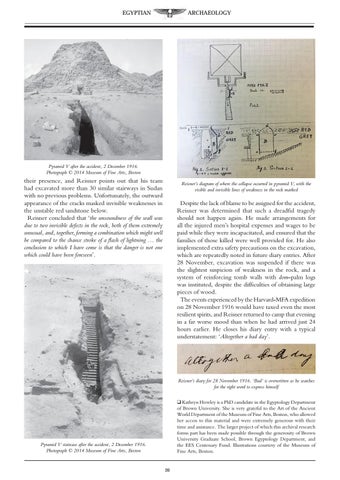
Pyramid V after the accident, 2 December 1916. Photograph © 2014 Museum of Fine Arts, Boston
their presence, and Reisner points out that his team had excavated more than 30 similar stairways in Sudan with no previous problems. Unfortunately, the outward appearance of the cracks masked invisible weaknesses in the unstable red sandstone below. Reisner concluded that ‘the unsoundness of the wall was due to two invisible defects in the rock, both of them extremely unusual, and, together, forming a combination which might well be compared to the chance stroke of a flash of lightning … the conclusion to which I have come is that the danger is not one which could have been foreseen’.
Reisner’s diagram of where the collapse occurred in pyramid V, with the visible and invisible lines of weakness in the rock marked
Despite the lack of blame to be assigned for the accident, Reisner was determined that such a dreadful tragedy should not happen again. He made arrangements for all the injured men’s hospital expenses and wages to be paid while they were incapacitated, and ensured that the families of those killed were well provided for. He also implemented extra safety precautions on the excavation, which are repeatedly noted in future diary entries. After 28 November, excavation was suspended if there was the slightest suspicion of weakness in the rock, and a system of reinforcing tomb walls with dom-palm logs was instituted, despite the difficulties of obtaining large pieces of wood. The events experienced by the Harvard-MFA expedition on 28 November 1916 would have taxed even the most resilient spirits, and Reisner returned to camp that evening in a far worse mood than when he had arrived just 24 hours earlier. He closes his diary entry with a typical understatement: ‘Altogether a bad day’.
Reisner’s diary for 28 November 1916. ‘Bad’ is overwritten as he searches for the right word to express himself q Kathryn Howley is a PhD candidate in the Egyptology Department of Brown University. She is very grateful to the Art of the Ancient World Department of the Museum of Fine Arts, Boston, who allowed her access to this material and were extremely generous with their time and assistance. The larger project of which this archival research forms part has been made possible through the generosity of Brown University Graduate School, Brown Egyptology Department, and the EES Centenary Fund. Illustrations courtesy of the Museum of Fine Arts, Boston.
Pyramid V staircase after the accident, 2 December 1916. Photograph © 2014 Museum of Fine Arts, Boston 20