EGYPTIAN
ARCHAEOLOGY
and IX, continuing exactly the same work that had been going on the previous day. The clearance was routine, and as the end of the work day at noon approached, no major finds had been made. Having completed his business in Kareima, Said boarded the ferry to cross the Nile back to Nuri. Suddenly another Egyptian appeared on the opposite bank of the river shouting terrible news; the stairway of pyramid V had collapsed on to the workmen excavating it. Said and the men with him ‘seized the oars of the ferry’ and rushed the boat to the bank. The news was not good. At 11:55am, just five minutes before work was due to end, a piece of rock had fallen at the very base of the staircase, trapping numerous men. Five were killed: two Egyptian foremen and three local Sudanese workmen. Said mourned that ‘Allah took them in [their] tracks’ and solemnly recorded their names.
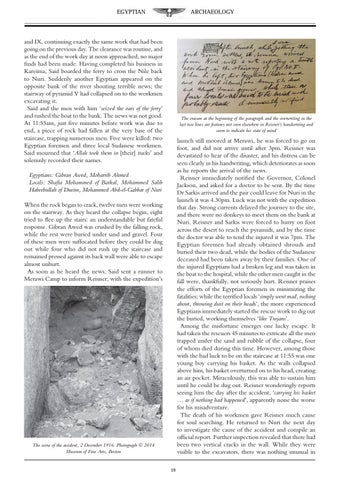
The erasure at the beginning of the paragraph and the overwriting in the last two lines are features not seen elsewhere in Reisner’s handwriting and seem to indicate his state of mind
launch still moored at Merawi, he was forced to go on foot, and did not arrive until after 3pm. Reisner was devastated to hear of the disaster, and his distress can be seen clearly in his handwriting, which deteriorates as soon as he reports the arrival of the news. Reisner immediately notified the Governor, Colonel Jackson, and asked for a doctor to be sent. By the time Dr Sarkis arrived and the pair could leave for Nuri in the launch it was 4.30pm. Luck was not with the expedition that day. Strong currents delayed the journey to the site, and there were no donkeys to meet them on the bank at Nuri. Reisner and Sarkis were forced to hurry on foot across the desert to reach the pyramids, and by the time the doctor was able to tend the injured it was 7pm. The Egyptian foremen had already obtained shrouds and buried their two dead, while the bodies of the Sudanese deceased had been taken away by their families. One of the injured Egyptians had a broken leg and was taken in the boat to the hospital, while the other men caught in the fall were, thankfully, not seriously hurt. Reisner praises the efforts of the Egyptian foremen in minimizing the fatalities; while the terrified locals ‘simply went mad, rushing about, throwing dust on their heads’, the more experienced Egyptians immediately started the rescue work to dig out the buried, working themselves ‘like Trojans’. Among the misfortune emerges one lucky escape. It had taken the rescuers 45 minutes to extricate all the men trapped under the sand and rubble of the collapse, four of whom died during this time. However, among those with the bad luck to be on the staircase at 11:55 was one young boy carrying his basket. As the walls collapsed above him, his basket overturned on to his head, creating an air pocket. Miraculously, this was able to sustain him until he could be dug out. Reisner wonderingly reports seeing him the day after the accident, ‘carrying his basket … as if nothing had happened’, apparently none the worse for his misadventure. The death of his workmen gave Reisner much cause for soul searching. He returned to Nuri the next day to investigate the cause of the accident and compile an official report. Further inspection revealed that there had been two vertical cracks in the wall. While they were visible to the excavators, there was nothing unusual in
Egyptians: Gibran Awed, Moharrib Ahmed Locals: Shafia Mohammed of Barkal, Mohammed Salib Habeebullah of Dueim, Mohammed Abd-el-Gabbar of Nuri When the rock began to crack, twelve men were working on the stairway. As they heard the collapse begin, eight tried to flee up the stairs: an understandable but fateful response. Gibran Awed was crushed by the falling rock, while the rest were buried under sand and gravel. Four of these men were suffocated before they could be dug out while four who did not rush up the staircase and remained pressed against its back wall were able to escape almost unhurt. As soon as he heard the news, Said sent a runner to Merawi Camp to inform Reisner; with the expedition’s
The scene of the accident, 2 December 1916. Photograph © 2014 Museum of Fine Arts, Boston 19