EGYPTIAN
ARCHAEOLOGY
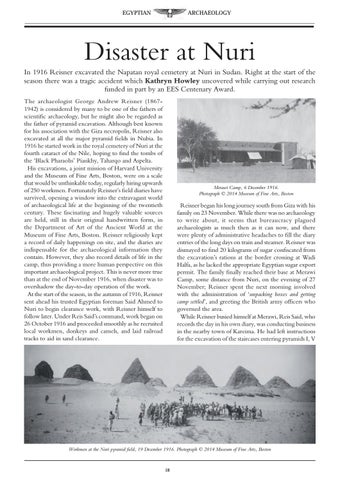
Disaster at Nuri In 1916 Reisner excavated the Napatan royal cemetery at Nuri in Sudan. Right at the start of the season there was a tragic accident which Kathryn Howley uncovered while carrying out research funded in part by an EES Centenary Award. The archaeologist George Andrew Reisner (18671942) is considered by many to be one of the fathers of scientific archaeology, but he might also be regarded as the father of pyramid excavation. Although best known for his association with the Giza necropolis, Reisner also excavated at all the major pyramid fields in Nubia. In 1916 he started work in the royal cemetery of Nuri at the fourth cataract of the Nile, hoping to find the tombs of the ‘Black Pharaohs’ Piankhy, Taharqo and Aspelta. His excavations, a joint mission of Harvard University and the Museum of Fine Arts, Boston, were on a scale that would be unthinkable today, regularly hiring upwards of 250 workmen. Fortunately Reisner’s field diaries have survived, opening a window into the extravagant world of archaeological life at the beginning of the twentieth century. These fascinating and hugely valuable sources are held, still in their original handwritten form, in the Department of Art of the Ancient World at the Museum of Fine Arts, Boston. Reisner religiously kept a record of daily happenings on site, and the diaries are indispensable for the archaeological information they contain. However, they also record details of life in the camp, thus providing a more human perspective on this important archaeological project. This is never more true than at the end of November 1916, when disaster was to overshadow the day-to-day operation of the work. At the start of the season, in the autumn of 1916, Reisner sent ahead his trusted Egyptian foreman Said Ahmed to Nuri to begin clearance work, with Reisner himself to follow later. Under Reis Said’s command, work began on 26 October 1916 and proceeded smoothly as he recruited local workmen, donkeys and camels, and laid railroad tracks to aid in sand clearance.
Merawi Camp, 6 December 1916. Photograph © 2014 Museum of Fine Arts, Boston
Reisner began his long journey south from Giza with his family on 23 November. While there was no archaeology to write about, it seems that bureaucracy plagued archaeologists as much then as it can now, and there were plenty of administrative headaches to fill the diary entries of the long days on train and steamer. Reisner was dismayed to find 20 kilograms of sugar confiscated from the excavation’s rations at the border crossing at Wadi Halfa, as he lacked the appropriate Egyptian sugar export permit. The family finally reached their base at Merawi Camp, some distance from Nuri, on the evening of 27 November; Reisner spent the next morning involved with the administration of ‘unpacking boxes and getting camp settled’, and greeting the British army officers who governed the area. While Reisner busied himself at Merawi, Reis Said, who records the day in his own diary, was conducting business in the nearby town of Kareima. He had left instructions for the excavation of the staircases entering pyramids I, V
Workmen at the Nuri pyramid field, 19 December 1916. Photograph © 2014 Museum of Fine Arts, Boston
18