EGYPTIAN
ARCHAEOLOGY
El-Hibeh, particularly relating to the Third Intermediate Period, is incalculable. Now, two years later, El-Hibeh remains unprotected, apart from the unarmed site guards who were unable to prevent earlier depredations, and site destruction, plundering and heritage loss generally in Egypt remain serious problems. Nevertheless, there are signs of hope. For El-Hibeh, the ‘master-criminal’ who organised the industrial-scale looting is dead, killed in an unrelated shootout with police. The pace and extent of looting at the site seems to have fallen off significantly, and it may yet prove possible to salvage some archaeological data. More broadly, the MSA is enjoying notable success in recovering stolen museum objects, repatriating pilfered items that surface abroad, and preventing looted materials from leaving the country in the first place. In April 2014, the Egyptian government, acknowledging that its cultural heritage is in serious jeopardy, formally requested a bilateral agreement with the United States under the Convention on Cultural Property Implementation Act. If recommended by the Cultural Property Advisory Committee and the State Department, and approved by President Obama, as seems likely, this agreement would restrict imports into the USA of endangered heritage
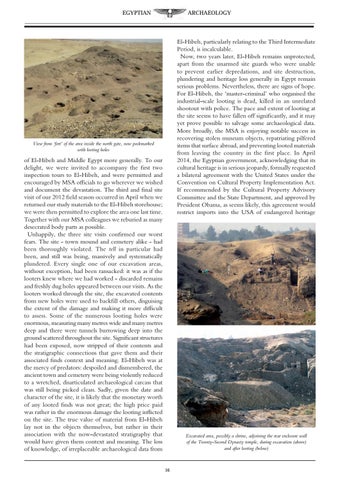
View from ‘fort’ of the area inside the north gate, now pockmarked with looting holes
of El-Hibeh and Middle Egypt more generally. To our delight, we were invited to accompany the first two inspection tours to El-Hibeh, and were permitted and encouraged by MSA officials to go wherever we wished and document the devastation. The third and final site visit of our 2012 field season occurred in April when we returned our study materials to the El-Hibeh storehouse; we were then permitted to explore the area one last time. Together with our MSA colleagues we reburied as many desecrated body parts as possible. Unhappily, the three site visits confirmed our worst fears. The site - town mound and cemetery alike - had been thoroughly violated. The tell in particular had been, and still was being, massively and systematically plundered. Every single one of our excavation areas, without exception, had been ransacked: it was as if the looters knew where we had worked - discarded remains and freshly dug holes appeared between our visits. As the looters worked through the site, the excavated contents from new holes were used to backfill others, disguising the extent of the damage and making it more difficult to assess. Some of the numerous looting holes were enormous, measuring many metres wide and many metres deep and there were tunnels burrowing deep into the ground scattered throughout the site. Significant structures had been exposed, now stripped of their contents and the stratigraphic connections that gave them and their associated finds context and meaning. El-Hibeh was at the mercy of predators: despoiled and dismembered, the ancient town and cemetery were being violently reduced to a wretched, disarticulated archaeological carcass that was still being picked clean. Sadly, given the date and character of the site, it is likely that the monetary worth of any looted finds was not great; the high price paid was rather in the enormous damage the looting inflicted on the site. The true value of material from El-Hibeh lay not in the objects themselves, but rather in their association with the now-devastated stratigraphy that would have given them context and meaning. The loss of knowledge, of irreplaceable archaeological data from
Excavated area, possibly a shrine, adjoining the rear enclosure wall of the Twenty-Second Dynasty temple, during excavation (above) and after looting (below)
16