EGYPTIAN
ARCHAEOLOGY
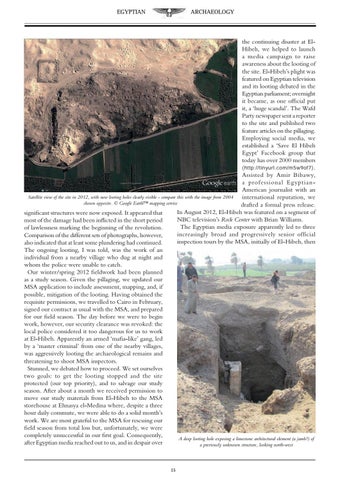
the continuing disaster at ElHibeh, we helped to launch a media campaign to raise awareness about the looting of the site. El-Hibeh’s plight was featured on Egyptian television and its looting debated in the Egyptian parliament; overnight it became, as one official put it, a ‘huge scandal’. The Wafd Party newspaper sent a reporter to the site and published two feature articles on the pillaging. Employing social media, we established a ‘Save El Hibeh Egypt’ Facebook group that today has over 2000 members ( http://tinyurl.com/m5w9of7 ). Assisted by Amir Bibawy, a professional EgyptianAmerican journalist with an Satellite view of the site in 2012, with new looting holes clearly visible - compare this with the image from 2004 international reputation, we shown opposite. © Google Earth™ mapping service drafted a formal press release. In August 2012, El-Hibeh was featured on a segment of significant structures were now exposed. It appeared that NBC television’s Rock Center with Brian Williams. most of the damage had been inflicted in the short period The Egyptian media exposure apparently led to three of lawlessness marking the beginning of the revolution. increasingly broad and progressively senior official Comparison of the different sets of photographs, however, inspection tours by the MSA, initially of El-Hibeh, then also indicated that at least some plundering had continued. The ongoing looting, I was told, was the work of an individual from a nearby village who dug at night and whom the police were unable to catch. Our winter/spring 2012 fieldwork had been planned as a study season. Given the pillaging, we updated our MSA application to include assessment, mapping, and, if possible, mitigation of the looting. Having obtained the requisite permissions, we travelled to Cairo in February, signed our contract as usual with the MSA, and prepared for our field season. The day before we were to begin work, however, our security clearance was revoked: the local police considered it too dangerous for us to work at El-Hibeh. Apparently an armed ‘mafia-like’ gang, led by a ‘master criminal’ from one of the nearby villages, was aggressively looting the archaeological remains and threatening to shoot MSA inspectors. Stunned, we debated how to proceed. We set ourselves two goals: to get the looting stopped and the site protected (our top priority), and to salvage our study season. After about a month we received permission to move our study materials from El-Hibeh to the MSA storehouse at Ehnasya el-Medina where, despite a three hour daily commute, we were able to do a solid month’s work. We are most grateful to the MSA for rescuing our field season from total loss but, unfortunately, we were completely unsuccessful in our first goal. Consequently, A deep looting hole exposing a limestone architectural element (a jamb?) of after Egyptian media reached out to us, and in despair over a previously unknown structure, looking north-west
15