EGYPTIAN
ARCHAEOLOGY
History and importance of the site The ancient Egyptian name of El-Hibeh was Teudjoi and in the Graeco-Roman Period it was known as Ankyronpolis. The town was founded on an irregular limestone outcrop at or near the edge of the Nile at the very beginning of the Libyan Third Intermediate Period (c.1070 BC). Once viewed as a historically irrelevant period of decline and cultural disintegration brought about by the decay of Bronze Age Egyptian power and glory, the Third Intermediate Period is now recognized as a multifaceted and protean time of changing societal paradigms for kingship and religion, temples and government, economics and social structure, art and mortuary practices. Unfortunately, our knowledge of the era is limited by the textual and archaeological sources that have survived. Few settlement sites in Egypt preserve Third Intermediate Period stratigraphy as extensively as El-Hibeh so the site is - or at least was - uniquely positioned to provide critical insights into Third Intermediate Period archaeology as well as providing information on Egyptian urbanism more generally. Teudjoi/Ankyronpolis was enveloped by a substantial town wall partly constructed of mud-bricks bearing the stamped names of either Pinudjem I (lower courses) or Menkheperre (higher courses), successive High Priests of Amun at Thebes in the Twenty-First Dynasty, and it is usually assumed that El-Hibeh marked the northern border of Theban authority at this time. Kilns scattered along the western edge of the site attest to industrial activity while an imposing height adjacent to the north gate has been identified as a fort but could also have been a large residence. A second desert gate is probably located somewhere along the eastern town wall. The most notable structure preserved at El-Hibeh is the small limestone
Part of a stamped brick of the High Priest of Amun, Menkheperre, originally from the town wall, reused in kiln structure
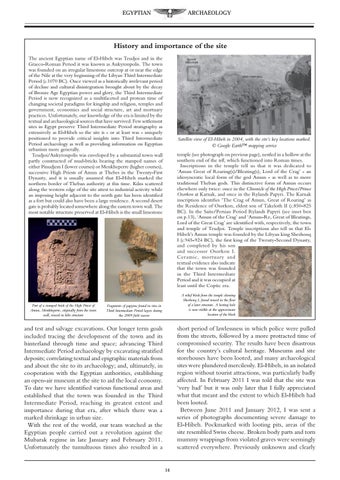
Satellite view of El-Hibeh in 2004, with the site’s key locations marked. © Google Earth™ mapping service temple (see photograph on previous page), nestled in a hollow at the southern end of the tell, which functioned into Roman times. Inscriptions in the temple tell us that it was dedicated to ‘Amun Great of Roaring(s)/Bleating(s), Lord of the Crag’ - an idiosyncratic local form of the god Amun - as well as to more traditional Theban gods. This distinctive form of Amun occurs elsewhere only twice: once in the Chronicle of the High Priest/Prince Osorkon at Karnak, and once in the Rylands Papyri. The Karnak inscription identifies ‘The Crag of Amun, Great of Roaring’ as the Residence of Osorkon, eldest son of Takeloth II (c.850-825 BC). In the Saite/Persian Period Rylands Papyri (see inset box on p.13), ‘Amun of the Crag’ and ‘Amun-Re, Great of Bleatings, Lord of the Great Crag’ are identified with, respectively, the town and temple of Teudjoi. Temple inscriptions also tell us that ElHibeh’s Amun temple was founded by the Libyan king Sheshonq I (c.945-924 BC), the first king of the Twenty-Second Dynasty, and completed by his son and successor Osorkon I. Ceramic, mortuary and textual evidence also indicate that the town was founded in the Third Intermediate Period and it was occupied at least until the Coptic era. A relief block from the temple showing Sheshonq I, found reused in the floor of a later structure. A looting hole is now visible at the approximate location of the block
Fragments of papyrus found in situ in Third Intermediate Period layers during the 2009 field season
short period of lawlessness in which police were pulled from the streets, followed by a more protracted time of compromised security. The results have been disastrous for the country’s cultural heritage. Museums and site storehouses have been looted, and many archaeological sites were plundered mercilessly. El-Hibeh, in an isolated region without tourist attractions, was particularly badly affected. In February 2011 I was told that the site was ‘very bad’ but it was only later that I fully appreciated what that meant and the extent to which El-Hibeh had been looted. Between June 2011 and January 2012, I was sent a series of photographs documenting severe damage to El-Hibeh. Pockmarked with looting pits, areas of the site resembled Swiss cheese. Broken body parts and torn mummy wrappings from violated graves were seemingly scattered everywhere. Previously unknown and clearly
and test and salvage excavations. Our longer term goals included tracing the development of the town and its hinterland through time and space; advancing Third Intermediate Period archaeology by excavating stratified deposits; correlating textual and epigraphic materials from and about the site to its archaeology; and, ultimately, in cooperation with the Egyptian authorities, establishing an open-air museum at the site to aid the local economy. To date we have identified various functional areas and established that the town was founded in the Third Intermediate Period, reaching its greatest extent and importance during that era, after which there was a marked shrinkage in urban size. With the rest of the world, our team watched as the Egyptian people carried out a revolution against the Mubarak regime in late January and February 2011. Unfortunately the tumultuous times also resulted in a 14