EGYPTIAN
ARCHAEOLOGY
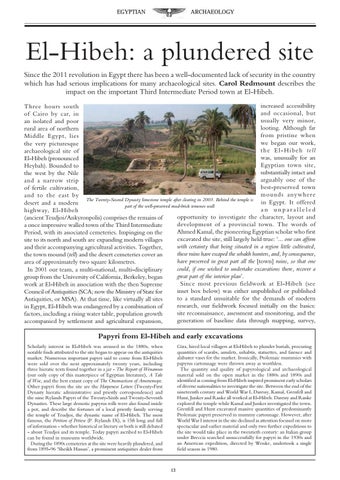
El-Hibeh: a plundered site Since the 2011 revolution in Egypt there has been a well-documented lack of security in the country which has had serious implications for many archaeological sites. Carol Redmount describes the impact on the important Third Intermediate Period town at El-Hibeh. increased accessibility Three hours south and occasional, but of Cairo by car, in usually very minor, an isolated and poor looting. Although far rural area of northern from pristine when Middle Egypt, lies we began our work, the very picturesque the El-Hibeh tell archaeological site of was, unusually for an El-Hibeh (pronounced Egyptian town site, Heybah). Bounded to substantially intact and the west by the Nile arguably one of the and a narrow strip best-preserved town of fertile cultivation, mounds anywhere and to the east by The Twenty-Second Dynasty limestone temple after clearing in 2003. Behind the temple is in Egypt. It offered desert and a modern part of the well-preserved mud-brick temenos wall an unparalleled highway, El-Hibeh opportunity to investigate the character, layout and (ancient Teudjoi/Ankyronpolis) comprises the remains of development of a provincial town. The words of a once impressive walled town of the Third Intermediate Ahmed Kamal, the pioneering Egyptian scholar who first Period, with its associated cemeteries. Impinging on the excavated the site, still largely held true: ‘... one can affirm site to its north and south are expanding modern villages with certainty that being situated in a region little cultivated, and their accompanying agricultural activities. Together, these ruins have escaped the sebakh hunters, and, by consequence, the town mound (tell) and the desert cemeteries cover an have preserved in great part all the [town] ruins, so that one area of approximately two square kilometres. could, if one wished to undertake excavations there, recover a In 2001 our team, a multi-national, multi-disciplinary great part of the interior plan’. group from the University of California, Berkeley, began Since most previous fieldwork at El-Hibeh (see work at El-Hibeh in association with the then Supreme inset box below) was either unpublished or published Council of Antiquities (SCA; now the Ministry of State for to a standard unsuitable for the demands of modern Antiquities, or MSA). At that time, like virtually all sites research, our fieldwork focused initially on the basics: in Egypt, El-Hibeh was endangered by a combination of site reconnaissance, assessment and monitoring, and the factors, including a rising water table, population growth generation of baseline data through mapping, survey, accompanied by settlement and agricultural expansion,
Papyri from El-Hibeh and early excavations Giza, hired local villagers at El-Hibeh to plunder burials, procuring quantities of scarabs, amulets, ushabtis, statuettes, and faience and alabaster vases for the market. Ironically, Ptolemaic mummies with papyrus cartonnage were thrown away as worthless. The quantity and quality of papyrological and archaeological material sold on the open market in the 1880s and 1890s and identified as coming from El-Hibeh inspired prominent early scholars of diverse nationalities to investigate the site. Between the end of the nineteenth century and World War I, Daressy, Kamal, Grenfell and Hunt, Junker and Ranke all worked at El-Hibeh. Daressy and Ranke explored the temple while Kamal and Junker investigated the town. Grenfell and Hunt excavated massive quantities of predominantly Ptolemaic papyri preserved in mummy cartonnage. However, after World War I interest in the site declined as attention focused on more spectacular and earlier material and only two further expeditions to the site would take place in the twentieth century: an Italian group under Breccia searched unsuccessfully for papyri in the 1930s and an American expedition, directed by Wenke, undertook a single field season in 1980.
Scholarly interest in El-Hibeh was aroused in the 1880s, when notable finds attributed to the site began to appear on the antiquities market. Numerous important papyri said to come from El-Hibeh were sold over the next approximately twenty years, including three hieratic texts found together in a jar - The Report of Wenamun (our only copy of this masterpiece of Egyptian literature), A Tale of Woe, and the best extant copy of The Onomasticon of Amenemope. Other papyri from the site are the Harpenese Letters (Twenty-First Dynasty hieratic administrative and priestly correspondence) and the nine Rylands Papyri of the Twenty-Sixth and Twenty-Seventh Dynasties. These large demotic papyrus rolls were also found inside a pot, and describe the fortunes of a local priestly family serving the temple of Teudjoi, the dynastic name of El-Hibeh. The most famous, the Petition of Petiese (P. Rylands IX), is 15ft long and full of information - whether historical or literary or both is still debated - about Teudjoi and its temple. Today papyri ascribed to El-Hibeh can be found in museums worldwide. During the 1890s cemeteries at the site were heavily plundered, and from 1895-96 ‘Sheikh Hassan’, a prominent antiquities dealer from
13