EGYPTIAN
ARCHAEOLOGY
Lake Ephemera formed after rain in 2013 (person on far shore for scale)
The temple at the surviving spring of Ain Amur where gazelle still roam
until the Roman Period in some parts of the oasis since skeletons from the site showed traces of bilharzia, while the description of Herodotus (c.450 BC) of a place seven days journey from Thebes as the ‘Isles of the Blessed’ might easily be a description of the watery Khargan area of that time, with settlements and temples on small rises within the residual lake. Despite the lowered lake level, the flat-lying fertile sediment that the lake left behind was easily irrigated with artesian water provided by springs along the major geological faults of the depression or extracted from wells. This bounty was not lost on the inhabitants of the region from the Middle Kingdom through to the Roman era, who used these ideal conditions to cultivate the famous wine-producing grapes of Kharga, among other crops. However, during this long stretch when the lakes and pools continued shrinking, salinity increased. Gypsum crystals growing in the upper layers of sediment are further evidence of a deterioration of the water quality. It is notable that the catfish and fresh water mussel that were reported by Françoise Briois and Béatrix Midant-Reynes are amongst the most tolerant of brackish conditions.
Wetter interludes continued to raise water levels, and rainy spells in the New Kingdom led to the reestablishment of pools in the earlier lake beds. These were regularly exploited, as attested by rock inscriptions and amphorae found in what is now deep desert. Again in the Roman Period rains re-filled the upper aquifer and modest communities sprang up, accessing this stored water through wells and manawir and qanats (subterranean water-harvesting tunnels, a technology possibly imported by the Persians, see Michel Wüttman’s article, EA 22, pp.36-37). Examples of the many Roman sites include Qasr el-Lebekha, Umm el-Dabadib, el-Deir and Qasr elSumayra. Subsequently the lake dried into ever smaller, and more widely dispersed pools until there were only a few springs remaining, with gazelle and ostrich still taking refuge there in the 1950s. Pumps brought in during the early twentieth century allowed the extraction of everdeeper water and renewal of the oasis. Of course in our own times of global temperature increase, rain is returning to the depression, creating modest ephemeral lakes and re-filling the upper sandstone aquifer. Gazelle, until recently restricted to pockets like the spring at Ain Amur, have started to roam further afield, grazing on plants that spring up in the playa basins as a direct result of this rainfall. While modern deep boreholes and high pressure irrigation sprinklers are spreading agriculture into the desert, might global temperature rise achieve the same end through increased rainfall re-greening the Sahara within our lifetimes?
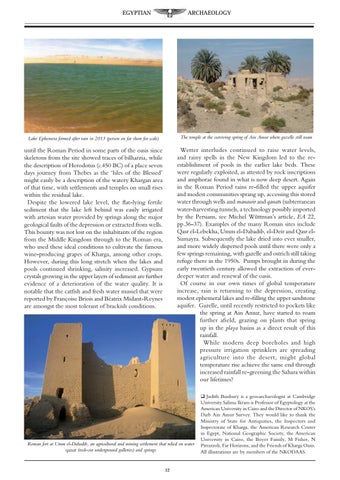
Roman fort at Umm el-Dabadib, an agricultural and mining settlement that relied on water qanat (rock-cut underground galleries) and springs
12
q Judith Bunbury is a geo-archaeologist at Cambridge University.Salima Ikram is Professor of Egyptology at the American University in Cairo and the Director of NKOS’s Darb Ain Amur Survey. They would like to thank the Ministry of State for Antiquities, the Inspectors and Inspectorate of Kharga, the American Research Center in Egypt, National Geographic Society, the American University in Cairo, the Boyer Family, M Fisher, N Pirrazzoli, Far Horizons, and the Friends of Kharga Oasis. All illustrations are by members of the NKODAAS.