EGYPTIAN
ARCHAEOLOGY
date, cannot have been dependent on that temple and the location of the Saite/Late Period temple at the site has yet to be identified. The discovery of a previously unknown New Kingdom temple at Tell Buweib is significant, especially as its mudbrick walls are preserved to a height of five metres above the ancient floor level. The reason for the abandonment of the temple in, probably, the early Third Intermediate Period is as yet unknown but could be related to the growing importance of the nearby site of Tanis. To excavate the Tell Buweib temple completely would be a massive, and expensive, task and our test trenches gave no indication that any of the original contents - stone elements, stelae, statues - might have been preserved. It would be interesting to know the ancient name of the site, and that of the god to whom the temple was dedicated, and probably the best hope of finding out this information will be if inscribed stonework from the temple has been reused elsewhere at the site.
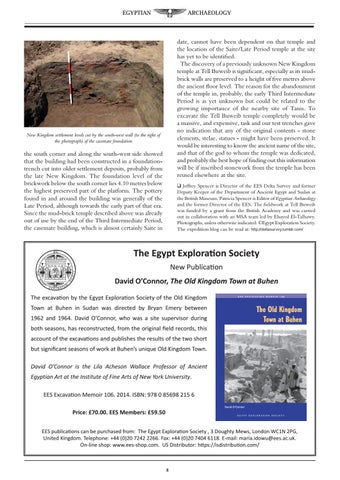
New Kingdom settlement levels cut by the south-west wall (to the right of the photograph) of the casemate foundation
the south corner and along the south-west side showed that the building had been constructed in a foundationtrench cut into older settlement deposits, probably from the late New Kingdom. The foundation level of the brickwork below the south corner lies 4.10 metres below the highest preserved part of the platform. The pottery found in and around the building was generally of the Late Period, although towards the early part of that era. Since the mud-brick temple described above was already out of use by the end of the Third Intermediate Period, the casemate building, which is almost certainly Saite in
q Jeffrey Spencer is Director of the EES Delta Survey and former Deputy Keeper of the Department of Ancient Egypt and Sudan at the British Museum. Patricia Spencer is Editor of Egyptian Archaeology and the former Director of the EES. The fieldwork at Tell Buweib was funded by a grant from the British Academy and was carried out in collaboration with an MSA team led by Elsayed El-Talhawy. Photographs, unless otherwise indicated: ©Egypt Exploration Society. The expedition blog can be read at: http://deltasurvey.tumblr.com/
The Egypt Exploration Society New Publication David O’Connor, The Old Kingdom Town at Buhen The excavation by the Egypt Exploration Society of the Old Kingdom E E S
E X C AVAT I O N
M E M O I R
1 0 6
E E S
E X C AVAT I O N
Town at Buhen in Sudan was directed by Bryan Emery between
account of the excavations and publishes the results of the two short Front cover; David O’Connor supervising fieldwork during the excavation of the Old Kingdom Town at Buhen. Photographs ©The Egypt Exploration Society.
but significant seasons of work at Buhen’s unique Old Kingdom Town. The excavation by the Egypt Exploration Society of the Old Kingdom Town at Buhen in Sudan was directed by Professor W B Emery between 1962 and 1964. David O’Connor, who was a site supervisor during both seasons, has reconstructed, from the original field records, this account of the excavations and publishes the results of the two short but significant seasons at Buhen’s unique Old Kingdom Town.
The Old Kingdom Town at Buhen
The principal team members who worked on the Old Kingdom Town excavations were Tony Mills (standing left), Bryan Emery (standing in centre) and David O’Connor (kneeling second right). They are seen here on Christmas Day 1960 at Buhen with (left to right) Molly Emery, Ricardo Caminos, Harry Smith and Robert Deane.
both seasons, has reconstructed, from the original field records, this
1 0 6
The Old Kingdom Town at Buhen
The Old Kingdom Town at Buhen
1962 and 1964. David O’Connor, who was a site supervisor during
M E M O I R
David O’Connor is the Lila Acheson Wallace Professor of Ancient David O’Connor
David O’Connor has had extensive archaeological experience in both Egypt and Sudan, including participation in EES fieldwork at Buhen and Qasr Ibrim. He has been Director of the continuing excavations at Abydos (University of Pennsylvania-Yale-Institute of Fine Arts/New York University) since 1964 and from 1964 to 1995 was a Professor of ancient Egyptian history and archaeology at the University of Pennsylvania and Curator-in-Charge of the Egyptian collection of the University’s Penn Museum. Professor O’Connor is currently the Lila Acheson Wallace Professor of Ancient Egyptian Art at the Institute of Fine Arts of New York University.
Egyptian Art at the Institute of Fine Arts of New York University.
EES Excavation Memoir 106. 2014. ISBN: 978 0 85698 215 6 ::H
Price: £70.00. EES Members: £59.50
:B &%+
David O’Connor E G Y P T
E X P L O R AT I O N
S O C I E T Y
EES publications can be purchased from: The Egypt Exploration Society , 3 Doughty Mews, London WC1N 2PG, United Kingdom. Telephone: +44 (0)20 7242 2266. Fax: +44 (0)20 7404 6118. E-mail: maria.idowu@ees.ac.uk. On-line shop: www.ees-shop.com. US Distributor: https://isdistribution.com/