EGYPTIAN
ARCHAEOLOGY
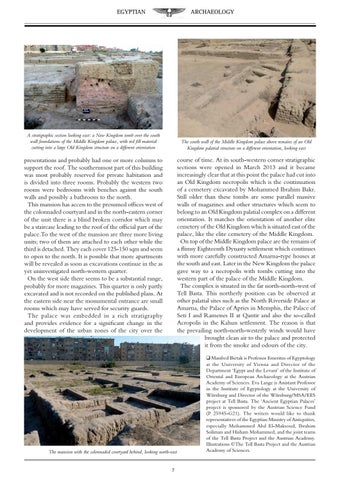
A stratigraphic section looking east: a New Kingdom tomb over the south wall foundations of the Middle Kingdom palace, with red fill material cutting into a large Old Kingdom structure on a different orientation
The south wall of the Middle Kingdom palace above remains of an Old Kingdom palatial structure on a different orientation, looking east
course of time. At its south-western corner stratigraphic sections were opened in March 2013 and it became increasingly clear that at this point the palace had cut into an Old Kingdom necropolis which is the continuation of a cemetery excavated by Mohammed Ibrahim Bakr. Still older than these tombs are some parallel massive walls of magazines and other structures which seem to belong to an Old Kingdom palatial complex on a different orientation. It matches the orientation of another elite cemetery of the Old Kingdom which is situated east of the palace, like the elite cemetery of the Middle Kingdom. On top of the Middle Kingdom palace are the remains of a flimsy Eighteenth Dynasty settlement which continues with more carefully constructed Amarna-type houses at the south and east. Later in the New Kingdom the palace gave way to a necropolis with tombs cutting into the western part of the palace of the Middle Kingdom. The complex is situated in the far north-north-west of Tell Basta. This northerly position can be observed at other palatial sites such as the North Riverside Palace at Amarna, the Palace of Apries in Memphis, the Palace of Seti I and Ramesses II at Qantir and also the so-called Acropolis in the Kahun settlement. The reason is that the prevailing north-north-westerly winds would have brought clean air to the palace and protected it from the smoke and odours of the city.
presentations and probably had one or more columns to support the roof. The southernmost part of this building was most probably reserved for private habitation and is divided into three rooms. Probably the western two rooms were bedrooms with benches against the south walls and possibly a bathroom to the north. This mansion has access to the presumed offices west of the colonnaded courtyard and in the north-eastern corner of the unit there is a blind broken corridor which may be a staircase leading to the roof of the official part of the palace.To the west of the mansion are three more living units; two of them are attached to each other while the third is detached. They each cover 125-150 sqm and seem to open to the north. It is possible that more apartments will be revealed as soon as excavations continue in the as yet uninvestigated north-western quarter. On the west side there seems to be a substantial range, probably for more magazines. This quarter is only partly excavated and is not recorded on the published plans. At the eastern side near the monumental entrance are small rooms which may have served for security guards. The palace was embedded in a rich stratigraphy and provides evidence for a significant change in the development of the urban zones of the city over the
The mansion with the colonnaded courtyard behind, looking north-east
q Manfred Bietak is Professor Emeritus of Egyptology at the University of Vienna and Director of the Department ‘Egypt and the Levant’ of the Institute of Oriental and European Archaeology at the Austrian Academy of Sciences. Eva Lange is Assistant Professor in the Institute of Egyptology at the University of Würzburg and Director of the Würzburg/MSA/EES project at Tell Basta. The ‘Ancient Egyptian Palaces’ project is sponsored by the Austrian Science Fund (P 25945-G21). The writers would like to thank representatives of the Egyptian Ministry of Antiquities, especially Mohammed Abd El-Maksoud, Ibrahim Soliman and Hisham Mohammed, and the joint teams of the Tell Basta Project and the Austrian Academy. Illustrations ©The Tell Basta Project and the Austrian Academy of Sciences.