EGYPTIAN
ARCHAEOLOGY
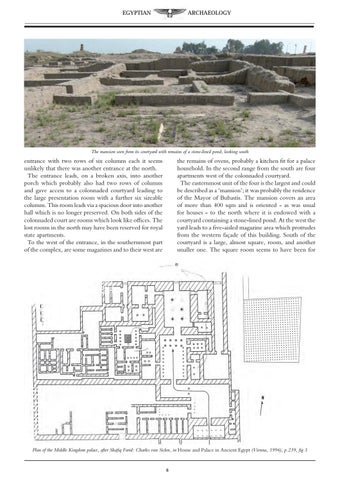
The mansion seen from its courtyard with remains of a stone-lined pond, looking south
entrance with two rows of six columns each it seems unlikely that there was another entrance at the north. The entrance leads, on a broken axis, into another porch which probably also had two rows of columns and gave access to a colonnaded courtyard leading to the large presentation room with a further six sizeable columns. This room leads via a spacious door into another hall which is no longer preserved. On both sides of the colonnaded court are rooms which look like offices. The lost rooms in the north may have been reserved for royal state apartments. To the west of the entrance, in the southernmost part of the complex, are some magazines and to their west are
the remains of ovens, probably a kitchen fit for a palace household. In the second range from the south are four apartments west of the colonnaded courtyard. The easternmost unit of the four is the largest and could be described as a ‘mansion’; it was probably the residence of the Mayor of Bubastis. The mansion covers an area of more than 400 sqm and is oriented - as was usual for houses - to the north where it is endowed with a courtyard containing a stone-lined pond. At the west the yard leads to a five-aisled magazine area which protrudes from the western façade of this building. South of the courtyard is a large, almost square, room, and another smaller one. The square room seems to have been for
Plan of the Middle Kingdom palace, after Shafiq Farid: Charles van Siclen, in House and Palace in Ancient Egypt (Vienna, 1996), p.239, fig.1