EGYPTIAN
ARCHAEOLOGY
Tell Basta: the palace of the Middle Kingdom On 12-14 June 2013 the EES hosted a conference on ‘Palaces and Residences in ancient Egypt’ following the establishment by the Austrian Academy of Sciences in Vienna of an Austrian Science Fund Project on ‘Ancient Egyptian Palaces’. Manfred Bietak, his team from the Austrian Academy, and Eva Lange are researching the Middle Kingdom Palace at Tell Basta for the Project. Although forming the ideological, cultural and administrative core of ancient Egyptian society, well documented royal palaces are still rare in the archaeological record and most of the available evidence derives from the New Kingdom. We know little about palaces of older periods but the palace of the Middle Kingdom at Tell Basta, ancient Bubastis in the eastern Delta, is a notable exception. Excavated by Shafiq Farid in the 1960s, Ahmed Essawi in the 1970s and Mohammed Ibrahim Bakr in the late 1970s and 1980s, the Tell Basta palace is still not yet fully explored and so far has been published only in preliminary reports. Our new project aims to reinvestigate this outstanding building and its historical and cultural context. Like all Near Eastern palaces, that at Tell Basta was constructed of mud-brick which is difficult to preserve if unprotected and the Ministry of State for Antiquities (MSA), under Mohammed Abd el-Maksoud, decided to protect the walls of the building under layers of
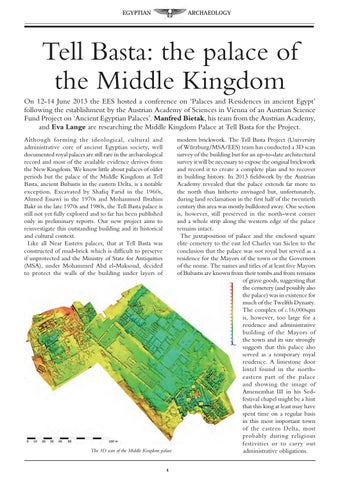
modern brickwork. The Tell Basta Project (University of Würzburg/MSA/EES) team has conducted a 3D scan survey of the building but for an up-to-date architectural survey it will be necessary to expose the original brickwork and record it to create a complete plan and to recover its building history. In 2013 fieldwork by the Austrian Academy revealed that the palace extends far more to the north than hitherto envisaged but, unfortunately, during land reclamation in the first half of the twentieth century this area was mostly bulldozed away. One section is, however, still preserved in the north-west corner and a whole strip along the western edge of the palace remains intact. The juxtaposition of palace and the enclosed square elite cemetery to the east led Charles van Siclen to the conclusion that the palace was not royal but served as a residence for the Mayors of the town or the Governors of the nome. The names and titles of at least five Mayors of Bubastis are known from their tombs and from remains of grave goods, suggesting that the cemetery (and possibly also the palace) was in existence for much of the Twelfth Dynasty. The complex of c.16,000sqm is, however, too large for a residence and administrative building of the Mayors of the town and its size strongly suggests that this palace also served as a temporary royal residence. A limestone door lintel found in the northeastern part of the palace and showing the image of Amenemhat III in his Sedfestival chapel might be a hint that this king at least may have spent time on a regular basis in this most important town of the eastern Delta, most probably during religious festivities or to carry out The 3D scan of the Middle Kingdom palace administrative obligations.