EGYPT’S SACRED ANIMALS
At the Egypt Exploration Society this Spring we are exploring the world of Ancient Egypt’s sacred animals. Through a series of events we will investigate why animals were important to the ancient Egyptians, why they were worshipped and how they came to be buried in vast underground catacombs. LONDON SEMINAR Snakes Alive! The Use of Figurative Language in the Tale of the Shipwrecked Sailor Saturday 12th April, 1-4pm Dr Linda Steynor This seminar will explore the use of figurative language in The Shipwrecked Sailor, highlighting issues of accessibility and appreciation. The hidden complexities of the Sailor’s apparently simple ‘tall tale’ will illustrate how his series of word-pictures offers a moral compass and provides a strategy for coping with the vicissitudes of life, as relevant now as for the ancient Egyptian.
LONDON SEMINAR The Telling Tails of Seth Saturday 10th May, 10am-4pm Dr Angela McDonald Alongside the many animals in the hieroglyphic script that play straightforward roles, there lurk some complex creatures with multiple meanings. With the sacred animal of Seth as a focal point, this seminar will explore the ways in which we can understand the Egyptians’ thoughts and experiences by analysing the animals – both real and imagined - that appear in their texts and art.
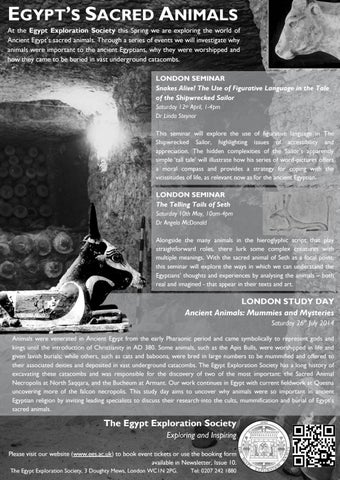
LONDON STUDY DAY Ancient Animals: Mummies and Mysteries Saturday 26th July 2014 Animals were venerated in Ancient Egypt from the early Pharaonic period and came symbolically to represent gods and kings until the introduction of Christianity in AD 380. Some animals, such as the Apis Bulls, were worshipped in life and given lavish burials; while others, such as cats and baboons, were bred in large numbers to be mummified and offered to their associated deities and deposited in vast underground catacombs. The Egypt Exploration Society has a long history of excavating these catacombs and was responsible for the discovery of two of the most important: the Sacred Animal Necropolis at North Saqqara, and the Bucheum at Armant. Our work continues in Egypt with current fieldwork at Quesna uncovering more of the falcon necropolis. This study day aims to uncover why animals were so important in ancient Egyptian religion by inviting leading specialists to discuss their research into the cults, mummification and burial of Egypt’s sacred animals.
The Egypt Exploration Society Exploring and Inspiring Please visit our website (www.ees.ac.uk) to book event tickets or use the booking form available in Newsletter, Issue 10. The Egypt Exploration Society, 3 Doughty Mews, London WC1N 2PG.
Tel: 0207 242 1880