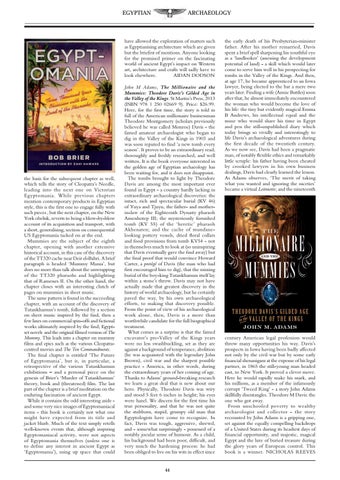
EGYPTIAN
ARCHAEOLOGY
have allowed the exploration of matters such as Egyptianising architecture which are given but the briefest of mentions. Anyone looking for the promised primer on the fascinating world of ancient Egypt’s impact on Western art, architecture and crafts will sadly have to look elsewhere. AIDAN DODSON
the basis for the subsequent chapter as well, which tells the story of Cleopatra’s Needle, leading into the next one on Victorian Egyptomania. While previous chapters mention contemporary products in Egyptian style, this is the first one to engage fully with such pieces , but the next chapter, on the New York obelisk, reverts to being a blow-by-blow account of its acquisition and transport, with a short, generalising, section on consequential US Egyptomania tacked on at the end. Mummies are the subject of the eighth chapter, opening with another extensive historical account, in this case of the discovery of the TT320 cache near Deir el-Bahri. A brief paragraph is headed ‘Mummy Mania’, but does no more than talk about the unwrapping of the TT320 pharaohs and highlighting that of Ramesses II. On the other hand, the chapter closes with an interesting clutch of pages on mummies in sheet music. The same pattern is found in the succeeding chapter, with an account of the discovery of Tutankhamun’s tomb, followed by a section on sheet music inspired by the find, then a few lines on commercial spin-offs and fictional works ultimately inspired by the find; Egyptset novels and the original filmed version of The Mummy. This leads into a chapter on mummy films and epics such as the various Cleopatracentred movies and The Ten Commandments. The final chapter is entitled ‘The Future of Egyptomania’, but is, in particular, a retrospective of the various Tutankhamun exhibitions – and a personal piece on the genesis of Brier’s ‘Murder of Tutankhamun’ theory, book and (threatened) film. The last part of the chapter is a brief meditation on the enduring fascination of ancient Egypt. While it contains the odd interesting aside and some very nice images of Egyptomaniacal items - this book is certainly not what one might have expected from its title and jacket blurb. Much of the text simply retells well-known events that, although inspiring Egyptomaniacal activity, were not aspects of Egyptomania themselves (unless one is to define any interest in ancient Egypt as ‘Egyptomania’), using up space that could
John M Adams, The Millionaire and the Mummies: Theodore Davis’s Gilded Age in the Valley of the Kings. St Martin’s Press, 2013 (ISBN 978 1 250 02669 9). Price: $26.99. Here, for the first time, the story is told in full of the American millionaire businessman Theodore Montgomery (scholars previously believed he was called Monroe) Davis - the famed amateur archaeologist who began to dig in the Valley of the Kings in 1903 and was soon reputed to find ‘a new tomb every season’. It proves to be an extraordinary read, thoroughly and freshly researched, and well written. It is the book everyone interested in the golden age of Egyptian archaeology has been waiting for, and it does not disappoint. The tombs brought to light by Theodore Davis are among the most important ever found in Egypt - a country hardly lacking in extraordinary archaeological discoveries: the intact, rich and spectacular burial (KV 46) of Yuya and Tjuyu, the father- and motherin-law of the Eighteenth Dynasty pharaoh Amenhotep III; the mysteriously furnished tomb (KV 55) of the ‘heretic’ pharaoh Akhenaten; and the cache of mundanelooking pottery vessels, dried floral collars and food provisions from tomb KV54 - not in themselves much to look at (so uninspiring that Davis eventually gave the find away) but the final proof that would convince Howard Carter, a protégé of Davis (the man who had first encouraged him to dig), that the missing burial of the boy-king Tutankhamun itself lay within a stone’s throw. Davis may not have actually made that greatest discovery in the history of world archaeology, but he certainly paved the way, by his own archaeological efforts, to making that discovery possible. From the point of view of his archaeological work alone, then, Davis is a more than worthwhile candidate for the full biographical treatment. What comes as a surprise is that the famed excavator’s pre-Valley of the Kings years were no less swashbuckling, set as they are against a background of temperance, abolition (he was acquainted with the legendary John Brown), civil war and the sharpest possible practice - America, in other words, during the extraordinary years of her coming of age. Thanks to Adams’ ground-breaking research we learn a great deal that is new about our hero. Physically, Theodore Davis was wiry and stood 5 feet 6 inches in height; his eyes were hazel. We discern for the first time his true personality, and that he was not quite the stubborn, stupid, grumpy old man that Egyptologists have come to recognize. In fact, Davis was tough, aggressive, shrewd, and - somewhat surprisingly - possessed of a notably jocular sense of humour. As a child, his background had been poor, difficult, and very much the hardening process: he had been obliged to live on his wits in effect since 44
the early death of his Presbyterian-minister father. After his mother remarried, Davis spent a brief spell sharpening his youthful eye as a ‘landlooker’ (assessing the development potential of land) - a skill which would later come to serve him well in his prospecting for tombs in the Valley of the Kings. And then, at age 17, he became apprenticed to an Iowa lawyer, being elected to the bar a mere two years later. Finding a wife (Annie Buttles) soon after that, he almost immediately encountered the woman who would become the love of his life: the tiny but evidently magical Emma B Andrews, his intellectual equal and the muse who would share his time in Egypt and pen the still-unpublished diary which today brings so vividly and interestingly to life Davis’s archaeological adventures during the first decade of the twentieth century. As we now see, Davis had been a pragmatic man, of notably flexible ethics and remarkably little scruple: his father having been cheated by crooked lawyers in his own business dealings, Davis had clearly learned the lesson. As Adams observes, ‘The merit of taking what you wanted and ignoring the niceties’ became a virtual Leitmotiv, and the nineteenth
century American legal profession would throw many opportunities his way. Davis’s prospects in Iowa having been badly affected not only by the civil war but by some early financial shenanigans at the expense of his legal partner, in 1865 the still-young man headed east, to New York. It proved a clever move. Here he would rapidly make his mark, and his millions, as a member of the infamously corrupt ‘Tweed Ring’ - a story John Adams skillfully disentangles. Theodore M Davis: the one who got away. From unschooled poverty to wealthy archaeologist and collector - the story recounted by John Adams is a gripping one, set against the equally compelling backdrops of a United States during its headiest days of financial opportunity, and majestic, magical Egypt and the lure of buried treasure during the glory years of European control. This book is a winner. NICHOLAS REEVES