EGYPTIAN
ARCHAEOLOGY
Attaching the missing piece of the first northern colossus from the west portico, found in a magazine and returned to the site
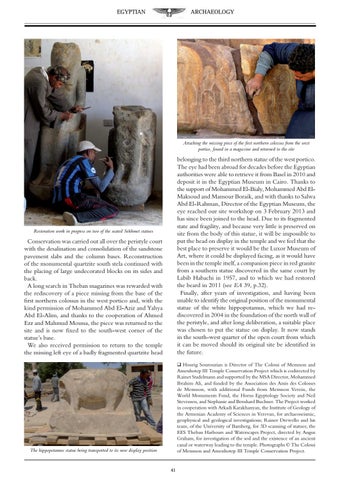
Conservation was carried out all over the peristyle court with the desalination and consolidation of the sandstone pavement slabs and the column bases. Reconstruction of the monumental quartzite south stela continued with the placing of large undecorated blocks on its sides and back. A long search in Theban magazines was rewarded with the rediscovery of a piece missing from the base of the first northern colossus in the west portico and, with the kind permission of Mohammed Abd El-Aziz and Yahya Abd El-Alim, and thanks to the cooperation of Ahmed Ezz and Mahmud Moussa, the piece was returned to the site and is now fixed to the south-west corner of the statue’s base. We also received permission to return to the temple the missing left eye of a badly fragmented quartzite head
belonging to the third northern statue of the west portico. The eye had been abroad for decades before the Egyptian authorities were able to retrieve it from Basel in 2010 and deposit it in the Egyptian Museum in Cairo. Thanks to the support of Mohammed El-Bialy, Mohammed Abd ElMaksoud and Mansour Boraik, and with thanks to Salwa Abd El-Rahman, Director of the Egyptian Museum, the eye reached our site workshop on 3 February 2013 and has since been joined to the head. Due to its fragmented state and fragility, and because very little is preserved on site from the body of this statue, it will be impossible to put the head on display in the temple and we feel that the best place to preserve it would be the Luxor Museum of Art, where it could be displayed facing, as it would have been in the temple itself, a companion piece in red granite from a southern statue discovered in the same court by Labib Habachi in 1957, and to which we had restored the beard in 2011 (see EA 39, p.32). Finally, after years of investigation, and having been unable to identify the original position of the monumental statue of the white hippopotamus, which we had rediscovered in 2004 in the foundation of the north wall of the peristyle, and after long deliberation, a suitable place was chosen to put the statue on display. It now stands in the south-west quarter of the open court from which it can be moved should its original site be identified in the future.
The hippopotamus statue being transported to its new display position
q Hourig Sourouzian is Director of The Colossi of Memnon and Amenhotep III Temple Conservation Project which is codirected by Rainet Stadelmann and supported by the MSA Director, Mohammed Ibrahim Ali, and funded by the Association des Amis des Colosses de Memnon, with additional Funds from Memnon Verein, the World Monuments Fund, the Horus Egyptology Society and Neil Stevensen, and Stephanie and Bernhard Buchner. The Project worked in cooperation with Arkadi Karakhanyan, the Institute of Geology of the Armenian Academy of Sciences in Yerevan, for archaeoseismic, geophysical and geological investigations; Rainer Drewello and his team, of the University of Bamberg, for 3D scanning of statues; the EES Theban Harbours and Waterscapes Project, directed by Angus Graham, for investigation of the soil and the existence of an ancient canal or waterway leading to the temple. Photographs Š The Colossi of Memnon and Amenhotep III Temple Conservation Project.
Restoration work in progress on two of the seated Sekhmet statues
41