EGYPTIAN
ARCHAEOLOGY
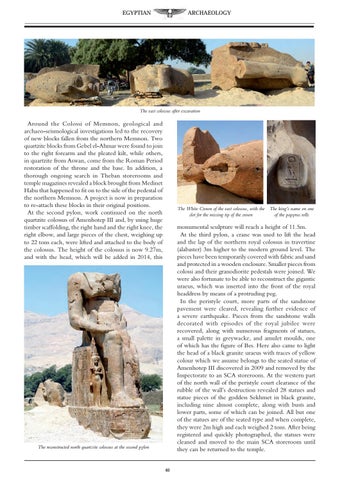
The east colossus after excavation
Around the Colossi of Memnon, geological and archaeo-seismological investigations led to the recovery of new blocks fallen from the northern Memnon. Two quartzite blocks from Gebel el-Ahmar were found to join to the right forearm and the pleated kilt, while others, in quartzite from Aswan, come from the Roman Period restoration of the throne and the base. In addition, a thorough ongoing search in Theban storerooms and temple magazines revealed a block brought from Medinet Habu that happened to fit on to the side of the pedestal of the northern Memnon. A project is now in preparation to re-attach these blocks in their original positions. At the second pylon, work continued on the north quartzite colossus of Amenhotep III and, by using huge timber scaffolding, the right hand and the right knee, the right elbow, and large pieces of the chest, weighing up to 22 tons each, were lifted and attached to the body of the colossus. The height of the colossus is now 9.27m, and with the head, which will be added in 2014, this
The White Crown of the east colossus, with the The king’s name on one slot for the missing tip of the crown of the papyrus rolls
monumental sculpture will reach a height of 11.5m. At the third pylon, a crane was used to lift the head and the lap of the northern royal colossus in travertine (alabaster) 3m higher to the modern ground level. The pieces have been temporarily covered with fabric and sand and protected in a wooden enclosure. Smaller pieces from colossi and their granodiorite pedestals were joined. We were also fortunate to be able to reconstruct the gigantic uraeus, which was inserted into the front of the royal headdress by means of a protruding peg. In the peristyle court, more parts of the sandstone pavement were cleared, revealing further evidence of a severe earthquake. Pieces from the sandstone walls decorated with episodes of the royal jubilee were recovered, along with numerous fragments of statues, a small palette in greywacke, and amulet moulds, one of which has the figure of Bes. Here also came to light the head of a black granite uraeus with traces of yellow colour which we assume belongs to the seated statue of Amenhotep III discovered in 2009 and removed by the Inspectorate to an SCA storeroom. At the western part of the north wall of the peristyle court clearance of the rubble of the wall’s destruction revealed 28 statues and statue pieces of the goddess Sekhmet in black granite, including nine almost complete, along with busts and lower parts, some of which can be joined. All but one of the statues are of the seated type and when complete, they were 2m high and each weighed 2 tons. After being registered and quickly photographed, the statues were cleaned and moved to the main SCA storeroom until they can be returned to the temple.
The reconstructed north quartzite colossus at the second pylon
40