EGYPTIAN
ARCHAEOLOGY
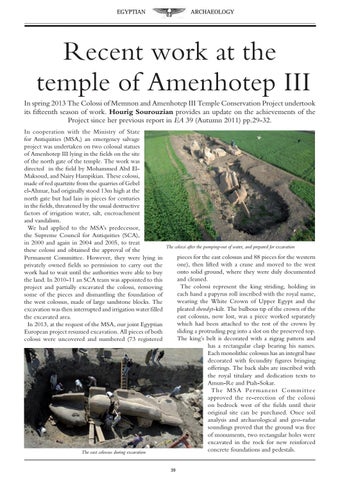
Recent work at the temple of Amenhotep III In spring 2013 The Colossi of Memnon and Amenhotep III Temple Conservation Project undertook its fifteenth season of work. Hourig Sourouzian provides an update on the achievements of the Project since her previous report in EA 39 (Autumn 2011) pp.29-32. In cooperation with the Ministry of State for Antiquities (MSA,) an emergency salvage project was undertaken on two colossal statues of Amenhotep III lying in the fields on the site of the north gate of the temple. The work was directed in the field by Mohammed Abd ElMaksoud, and Nairy Hampikian. These colossi, made of red quartzite from the quarries of Gebel el-Ahmar, had originally stood 13m high at the north gate but had lain in pieces for centuries in the fields, threatened by the usual destructive factors of irrigation water, salt, encroachment and vandalism. We had applied to the MSA’s predecessor, the Supreme Council for Antiquities (SCA), in 2000 and again in 2004 and 2005, to treat The colossi after the pumping-out of water, and prepared for excavation these colossi and obtained the approval of the pieces for the east colossus and 88 pieces for the western Permanent Committee. However, they were lying in one), then lifted with a crane and moved to the west privately owned fields so permission to carry out the onto solid ground, where they were duly documented work had to wait until the authorities were able to buy and cleaned. the land. In 2010-11 an SCA team was appointed to this The colossi represent the king striding, holding in project and partially excavated the colossi, removing each hand a papyrus roll inscribed with the royal name, some of the pieces and dismantling the foundation of wearing the White Crown of Upper Egypt and the the west colossus, made of large sandstone blocks. The pleated shendyt-kilt. The bulbous tip of the crown of the excavation was then interrupted and irrigation water filled east colossus, now lost, was a piece worked separately the excavated area. which had been attached to the rest of the crown by In 2013, at the request of the MSA, our joint Egyptian sliding a protruding peg into a slot on the preserved top. European project resumed excavation. All pieces of both The king’s belt is decorated with a zigzag pattern and colossi were uncovered and numbered (73 registered has a rectangular clasp bearing his names. Each monolithic colossus has an integral base decorated with fecundity figures bringing offerings. The back slabs are inscribed with the royal titulary and dedication texts to Amun-Re and Ptah-Sokar. The MSA Permanent Committee approved the re-erection of the colossi on bedrock west of the fields until their original site can be purchased. Once soil analysis and archaeological and geo-radar soundings proved that the ground was free of monuments, two rectangular holes were excavated in the rock for new reinforced concrete foundations and pedestals. The east colossus during excavation 39