EGYPTIAN
ARCHAEOLOGY
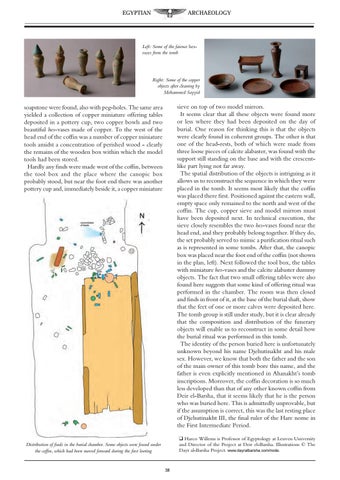
Left: Some of the faience hesvases from the tomb
Right: Some of the copper objects after cleaning by Mohammed Sayyid
sieve on top of two model mirrors. It seems clear that all these objects were found more or less where they had been deposited on the day of burial. One reason for thinking this is that the objects were clearly found in coherent groups. The other is that one of the head-rests, both of which were made from three loose pieces of calcite alabaster, was found with the support still standing on the base and with the crescentlike part lying not far away. The spatial distribution of the objects is intriguing as it allows us to reconstruct the sequence in which they were placed in the tomb. It seems most likely that the coffin was placed there first. Positioned against the eastern wall, empty space only remained to the north and west of the coffin. The cup, copper sieve and model mirrors must have been deposited next. In technical execution, the sieve closely resembles the two hes-vases found near the head end, and they probably belong together. If they do, the set probably served to mimic a purification ritual such as is represented in some tombs. After that, the canopic box was placed near the foot end of the coffin (not shown in the plan, left). Next followed the tool box, the tables with miniature hes-vases and the calcite alabaster dummy objects. The fact that two small offering tables were also found here suggests that some kind of offering ritual was performed in the chamber. The room was then closed and finds in front of it, at the base of the burial shaft, show that the feet of one or more calves were deposited here. The tomb group is still under study, but it is clear already that the composition and distribution of the funerary objects will enable us to reconstruct in some detail how the burial ritual was performed in this tomb. The identity of the person buried here is unfortunately unknown beyond his name Djehutinakht and his male sex. However, we know that both the father and the son of the main owner of this tomb bore this name, and the father is even explicitly mentioned in Ahanakht’s tomb inscriptions. Moreover, the coffin decoration is so much less developed than that of any other known coffin from Deir el-Barsha, that it seems likely that he is the person who was buried here. This is admittedly unprovable, but if the assumption is correct, this was the last resting place of Djehutinakht III, the final ruler of the Hare nome in the First Intermediate Period.
soapstone were found, also with peg-holes. The same area yielded a collection of copper miniature offering tables deposited in a pottery cup, two copper bowls and two beautiful hes-vases made of copper. To the west of the head end of the coffin was a number of copper miniature tools amidst a concentration of perished wood - clearly the remains of the wooden box within which the model tools had been stored. Hardly any finds were made west of the coffin, between the tool box and the place where the canopic box probably stood, but near the foot end there was another pottery cup and, immediately beside it, a copper miniature
q Harco Willems is Professor of Egyptology at Leuven University and Director of the Project at Deir el-Barsha. Illustrations Š The Dayr al-Barsha Project. www.dayralbarsha.com/node.
Distribution of finds in the burial chamber. Some objects were found under the coffin, which had been moved forward during the first looting 38