EGYPTIAN
ARCHAEOLOGY
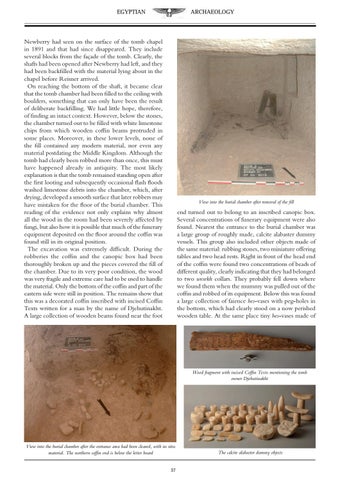
Newberry had seen on the surface of the tomb chapel in 1891 and that had since disappeared. They include several blocks from the faรงade of the tomb. Clearly, the shafts had been opened after Newberry had left, and they had been backfilled with the material lying about in the chapel before Reisner arrived. On reaching the bottom of the shaft, it became clear that the tomb chamber had been filled to the ceiling with boulders, something that can only have been the result of deliberate backfilling. We had little hope, therefore, of finding an intact context. However, below the stones, the chamber turned out to be filled with white limestone chips from which wooden coffin beams protruded in some places. Moreover, in these lower levels, none of the fill contained any modern material, nor even any material postdating the Middle Kingdom. Although the tomb had clearly been robbed more than once, this must have happened already in antiquity. The most likely explanation is that the tomb remained standing open after the first looting and subsequently occasional flash floods washed limestone debris into the chamber, which, after drying, developed a smooth surface that later robbers may have mistaken for the floor of the burial chamber. This reading of the evidence not only explains why almost all the wood in the room had been severely affected by fungi, but also how it is possible that much of the funerary equipment deposited on the floor around the coffin was found still in its original position. The excavation was extremely difficult. During the robberies the coffin and the canopic box had been thoroughly broken up and the pieces covered the fill of the chamber. Due to its very poor condition, the wood was very fragile and extreme care had to be used to handle the material. Only the bottom of the coffin and part of the eastern side were still in position. The remains show that this was a decorated coffin inscribed with incised Coffin Texts written for a man by the name of Djehutinakht. A large collection of wooden beams found near the foot
View into the burial chamber after removal of the fill
end turned out to belong to an inscribed canopic box. Several concentrations of funerary equipment were also found. Nearest the entrance to the burial chamber was a large group of roughly made, calcite alabaster dummy vessels. This group also included other objects made of the same material: rubbing stones, two miniature offering tables and two head rests. Right in front of the head end of the coffin were found two concentrations of beads of different quality, clearly indicating that they had belonged to two wesekh collars. They probably fell down where we found them when the mummy was pulled out of the coffin and robbed of its equipment. Below this was found a large collection of faience hes-vases with peg-holes in the bottom, which had clearly stood on a now perished wooden table. At the same place tiny hes-vases made of
Wood fragment with incised Coffin Texts mentioning the tomb owner Djehutinakht
View into the burial chamber after the entrance area had been cleared, with in situ material. The northern coffin end is below the letter board 37
The calcite alabaster dummy objects