EGYPTIAN
ARCHAEOLOGY
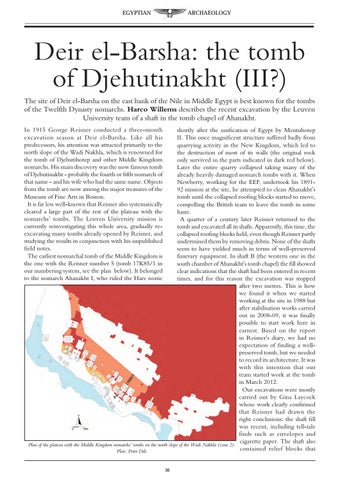
Deir el-Barsha: the tomb of Djehutinakht (III?) The site of Deir el-Barsha on the east bank of the Nile in Middle Egypt is best known for the tombs of the Twelfth Dynasty nomarchs. Harco Willems describes the recent excavation by the Leuven University team of a shaft in the tomb chapel of Ahanakht. In 1915 George Reisner conducted a three-month excavation season at Deir el-Barsha. Like all his predecessors, his attention was attracted primarily to the north slope of the Wadi Nakhla, which is renowned for the tomb of Djehutihotep and other Middle Kingdom nomarchs. His main discovery was the now famous tomb of Djehutinakht - probably the fourth or fifth nomarch of that name - and his wife who had the same name. Objects from the tomb are now among the major treasures of the Museum of Fine Arts in Boston. It is far less well-known that Reisner also systematically cleared a large part of the rest of the plateau with the nomarchs’ tombs. The Leuven University mission is currently reinvestigating this whole area, gradually reexcavating many tombs already opened by Reisner, and studying the results in conjunction with his unpublished field notes. The earliest nomarchal tomb of the Middle Kingdom is the one with the Reisner number 5 (tomb 17K85/1 in our numbering system, see the plan below). It belonged to the nomarch Ahanakht I, who ruled the Hare nome
shortly after the unification of Egypt by Mentuhotep II. This once magnificent structure suffered badly from quarrying activity in the New Kingdom, which led to the destruction of most of its walls (the original rock only survived in the parts indicated in dark red below). Later the entire quarry collapsed taking many of the already heavily damaged nomarch tombs with it. When Newberry, working for the EEF, undertook his 189192 mission at the site, he attempted to clean Ahanakht’s tomb until the collapsed roofing blocks started to move, compelling the British team to leave the tomb in some haste. A quarter of a century later Reisner returned to the tomb and excavated all its shafts. Apparently, this time, the collapsed roofing blocks held, even though Reisner partly undermined them by removing debris. None of the shafts seem to have yielded much in terms of well-preserved funerary equipment. In shaft B (the western one in the south chamber of Ahanakht’s tomb chapel) the fill showed clear indications that the shaft had been entered in recent times, and for this reason the excavation was stopped after two metres. This is how we found it when we started working at the site in 1988 but after stabilisation works carried out in 2008-09, it was finally possible to start work here in earnest. Based on the report in Reisner’s diary, we had no expectation of finding a wellpreserved tomb, but we needed to record its architecture. It was with this intention that our team started work at the tomb in March 2012. Our excavations were mostly carried out by Gina Laycock whose work clearly confirmed that Reisner had drawn the right conclusions: the shaft fill was recent, including tell-tale finds such as envelopes and cigarette paper. The shaft also Plan of the plateau with the Middle Kingdom nomarchs’ tombs on the north slope of the Wadi Nakhla (zone 2). contained relief blocks that Plan: Peter Dils 36