EGYPTIAN
ARCHAEOLOGY
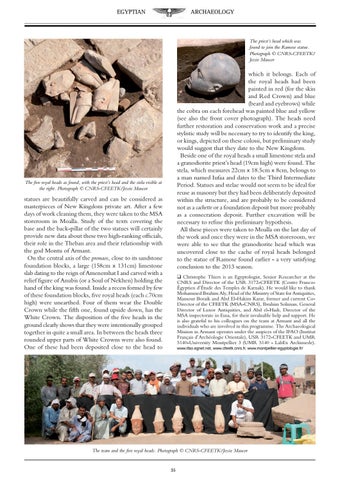
The priest’s head which was found to join the Ramose statue. Photograph © CNRS-CFEETK/ Jessie Maucor
which it belongs. Each of the royal heads had been painted in red (for the skin and Red Crown) and blue (beard and eyebrows) while the cobra on each forehead was painted blue and yellow (see also the front cover photograph). The heads need further restoration and conservation work and a precise stylistic study will be necessary to try to identify the king, or kings, depicted on these colossi, but preliminary study would suggest that they date to the New Kingdom. Beside one of the royal heads a small limestone stela and a granodiorite priest’s head (19cm high) were found. The stela, which measures 22cm x 18.5cm x 8cm, belongs to a man named Iufaa and dates to the Third Intermediate Period. Statues and stelae would not seem to be ideal for reuse as masonry but they had been deliberately deposited within the structure, and are probably to be considered not as a cachette or a foundation deposit but more probably as a consecration deposit. Further excavation will be necessary to refine this preliminary hypothesis. All these pieces were taken to Moalla on the last day of the work and once they were in the MSA storeroom, we were able to see that the granodiorite head which was uncovered close to the cache of royal heads belonged to the statue of Ramose found earlier - a very satisfying conclusion to the 2013 season.
The five royal heads as found, with the priest’s head and the stela visible at the right. Photograph © CNRS-CFEETK/Jessie Maucor
statues are beautifully carved and can be considered as masterpieces of New Kingdom private art. After a few days of work cleaning them, they were taken to the MSA storeroom in Moalla. Study of the texts covering the base and the back-pillar of the two statues will certainly provide new data about these two high-ranking officials, their role in the Theban area and their relationship with the god Montu of Armant. On the central axis of the pronaos, close to its sandstone foundation blocks, a large (158cm x 131cm) limestone slab dating to the reign of Amenemhat I and carved with a relief figure of Anubis (or a Soul of Nekhen) holding the hand of the king was found. Inside a recess formed by few of these foundation blocks, five royal heads (each c.70cm high) were unearthed. Four of them wear the Double Crown while the fifth one, found upside down, has the White Crown. The disposition of the five heads in the ground clearly shows that they were intentionally grouped together in quite a small area. In between the heads three rounded upper parts of White Crowns were also found. One of these had been deposited close to the head to
q Christophe Thiers is an Egyptologist, Senior Researcher at the CNRS and Director of the USR 3172-CFEETK (Centre FrancoÉgyptien d’Étude des Temples de Karnak). He would like to thank Mohammed Ibrahim Aly, Head of the Ministry of State for Antiquities, Mansour Boraik and Abd El-Hakim Karar, former and current CoDirector of the CFEETK (MSA-CNRS), Ibrahim Soliman, General Director of Luxor Antiquities, and Abd el-Hadi, Director of the MSA inspectorate in Esna, for their invaluable help and support. He is also grateful to his colleagues on the team at Armant and all the individuals who are involved in this programme. The Archaeological Mission in Armant operates under the auspices of the IFAO (Institut Français d’Archéologie Orientale), USR 3172-CFEETK and UMR 5140-University Montpellier 3 (UMR 5140 - LabEx Archimede). www.ifao.egnet.net, www.cfeetk.cnrs.fr, www.montpellier-egyptologie.fr/
The team and the five royal heads. Photograph © CNRS-CFEETK/Jessie Maucor 35