EGYPTIAN
ARCHAEOLOGY
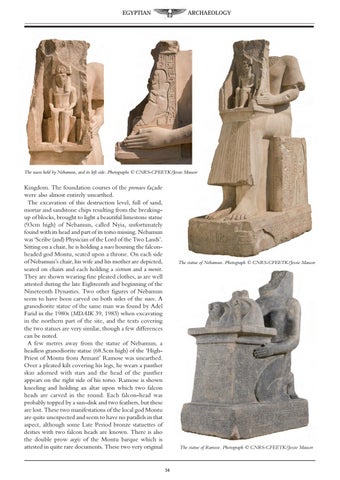
The naos held by Nebamun, and its left side. Photographs © CNRS-CFEETK/Jessie Maucor
Kingdom. The foundation courses of the pronaos façade were also almost entirely unearthed. The excavation of this destruction level, full of sand, mortar and sandstone chips resulting from the breakingup of blocks, brought to light a beautiful limestone statue (93cm high) of Nebamun, called Nyia, unfortunately found with its head and part of its torso missing. Nebamun was ‘Scribe (and) Physician of the Lord of the Two Lands’. Sitting on a chair, he is holding a naos housing the falconheaded god Montu, seated upon a throne. On each side of Nebamun’s chair, his wife and his mother are depicted, seated on chairs and each holding a sistrum and a menit. They are shown wearing fine pleated clothes, as are well attested during the late Eighteenth and beginning of the Nineteenth Dynasties. Two other figures of Nebamun seem to have been carved on both sides of the naos. A granodiorite statue of the same man was found by Adel Farid in the 1980s (MDAIK 39, 1983) when excavating in the northern part of the site, and the texts covering the two statues are very similar, though a few differences can be noted. A few metres away from the statue of Nebamun, a headless granodiorite statue (68.5cm high) of the ‘HighPriest of Montu from Armant’ Ramose was unearthed. Over a pleated kilt covering his legs, he wears a panther skin adorned with stars and the head of the panther appears on the right side of his torso. Ramose is shown kneeling and holding an altar upon which two falcon heads are carved in the round. Each falcon-head was probably topped by a sun-disk and two feathers, but these are lost. These two manifestations of the local god Montu are quite unexpected and seem to have no parallels in that aspect, although some Late Period bronze statuettes of deities with two falcon heads are known. There is also the double prow aegis of the Montu barque which is attested in quite rare documents. These two very original
The statue of Nebamun. Photograph © CNRS-CFEETK/Jessie Maucor
The statue of Ramose. Photograph © CNRS-CFEETK/Jessie Maucor
34