EGYPTIAN
ARCHAEOLOGY
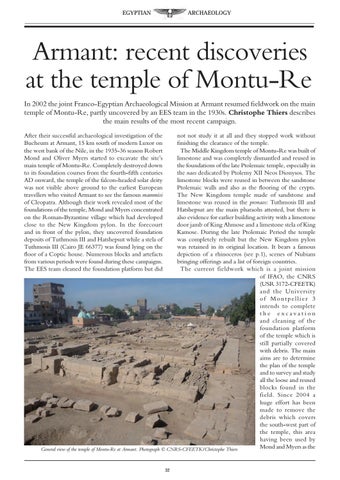
Armant: recent discoveries at the temple of Montu-Re In 2002 the joint Franco-Egyptian Archaeological Mission at Armant resumed fieldwork on the main temple of Montu-Re, partly uncovered by an EES team in the 1930s. Christophe Thiers describes the main results of the most recent campaign. After their successful archaeological investigation of the Bucheum at Armant, 15 km south of modern Luxor on the west bank of the Nile, in the 1935-36 season Robert Mond and Oliver Myers started to excavate the site’s main temple of Montu-Re. Completely destroyed down to its foundation courses from the fourth-fifth centuries AD onward, the temple of the falcon-headed solar deity was not visible above ground to the earliest European travellers who visited Armant to see the famous mammisi of Cleopatra. Although their work revealed most of the foundations of the temple, Mond and Myers concentrated on the Roman-Byzantine village which had developed close to the New Kingdom pylon. In the forecourt and in front of the pylon, they uncovered foundation deposits of Tuthmosis III and Hatshepsut while a stela of Tuthmosis III (Cairo JE 66377) was found lying on the floor of a Coptic house. Numerous blocks and artefacts from various periods were found during these campaigns. The EES team cleaned the foundation platform but did
not not study it at all and they stopped work without finishing the clearance of the temple. The Middle Kingdom temple of Montu-Re was built of limestone and was completely dismantled and reused in the foundations of the late Ptolemaic temple, especially in the naos dedicated by Ptolemy XII Neos Dionysos. The limestone blocks were reused in between the sandstone Ptolemaic walls and also as the flooring of the crypts. The New Kingdom temple made of sandstone and limestone was reused in the pronaos: Tuthmosis III and Hatshepsut are the main pharaohs attested, but there is also evidence for earlier building activity with a limestone door jamb of King Ahmose and a limestone stela of King Kamose. During the late Ptolemaic Period the temple was completely rebuilt but the New Kingdom pylon was retained in its original location. It bears a famous depiction of a rhinoceros (see p.1), scenes of Nubians bringing offerings and a list of foreign countries. The current fieldwork which is a joint mission of IFAO, the CNRS (USR 3172-CFEETK) and the University of Montpellier 3 intends to complete the excavation and cleaning of the foundation platform of the temple which is still partially covered with debris. The main aims are to determine the plan of the temple and to survey and study all the loose and reused blocks found in the field. Since 2004 a huge effort has been made to remove the debris which covers the south-west part of the temple, this area having been used by Mond and Myers as the General view of the temple of Montu-Re at Armant. Photograph © CNRS-CFEETK/Christophe Thiers 32