EGYPTIAN
all over the ‘churches area’. The architectural study of the E and N porticoes, built during the first decades of Roman rule on top of the Hellenistic wall, revealed a new access to the main temenos, passing over the Greek precinct. www.ifao.egnet.net/ archeologie/coptos/ and http://tinyurl.com/m265xuj. Karnak: 1. The CFEETK (MSA/CNRS USR 3172) programmes of archaeological research and conservation continued at Karnak, directed by Mansour Boraik and then by Abdel Hakim Karar, and Christophe Thiers. Under the supervision of Pauline Calassou (LabEx Archimede), the epigraphic survey of the N storerooms of Tuthmosis III continued. Led in cooperation with Christian Leitz (Univ of Tübingen), the conservation programme of the N part of the Akh-menu started at the Chapel of Alexander the Great. At the Ptah Temple (which is now officially open for tourists), the conservation and restoration programme focused on the granodiorite column bases located on the S axis, and on a small Ptolemaic gate SE of the Temple. Excavations led by Benjamin Durand focused on mud-brick walls and mud-brick structures S of the Temple while Elizabeth Frood (Univ of Oxford) completed study of the graffiti and Romain David (LabEx Archimede) studied the ceramics. In the Amun Temple a new epigraphic programme using orthophotographs (aerial images geometrically corrected) started at the VIIIth Pylon, under the supervision of Sébastien Biston-Moulin and Elizabeth Frood. 2. In the Mut Temple at Karnak an ARCE project, directed by John Shearman with Andrew Bednarski as Project Egyptologist and funded through USAID, continued improving walkways, lighting, and the sacred lake area. Luxor: The OI team, directed by W Raymond Johnson, inaugurated a new Luxor Temple blockyard data management programme under the direction of OI architect James B Heidel to facilitate the expanding documentation and analysis of the miscellaneous, inscribed fragmentary wall and architectural material in the blockyard storage areas. Epigrapher Jen Kimpton, assisted by Andrea Dudek, designed a new database for the 50,000 blocks already in the blockyard which will also accommodate any future material. Digital facsimile epigraphic documentation of the Bentresh block inscription material began utilising the new Cintiq Wacom Companion drawing tablet. http:// oi.uchicago.edu/research/projects/epi/
Western Thebes: 1. ARCE’s programme of work, funded through USAID and directed by John Shearman with
ARCHAEOLOGY
Andrew Bednarski as Project Egyptologist, ran throughout 2013, with an anticipated end date of July 2014. It comprises a number of initiatives that incorporate conservation and archaeological field schools and by June 2013, more than 100 MSA conservators and inspectors had graduated from ARCE’s training programmes. The Qurna Site Improvement Project, led in the field by Andrew Bednarski, continued manually removing debris from the area of Sheikh Abd el-Qurna and El-Khokha. This work is supervised by archaeologists who record ancient and modern objects recovered, the remains of the modern hamlets, and ethnographic information on the former occupants. Work began on new pathways, and plans for new signage and an improved visitor lighting system. See: http://arce.org/conservation/Qurna/ qurna-overview. In the tomb of Djehuty (TT 110), the aim is to clear, clean and conserve the tomb to open it for visitors. ARCE’s Preparatory Archaeological Field School for local MSA inspectors excavated a large portion of the material on top of the ancient forecourt. This school marks the first of its kind for ARCE, in that it was organized, taught, and run completely by Egyptian archaeologists trained through Ancient Egypt Research Associates. http://arce.org/conservation/ fieldschool/TT110. Running in tandem with this field school is a Conservation Field School for MSA conservators who are cleaning and consolidating large portions of the tomb’s painted walls. ARCE’s archaeologists also excavated TT 110’s burial shaft and explored related subterranean chambers. Further clearance will continue to enable visitor access to the tomb through its original entrance. At Deir el-Shelwit (c.4km S of Medinet Habu) cleaning and conservation of the Roman Temple of Isis continued, with another ARCE conservation field school until June 2013 and from autumn 2013 continuing into 2014. 2. At Medinet Habu the OI epigraphic team, directed by W Raymond Johnson and under the supervision of Brett McClain, resumed documentation in the small Amun temple of Hatshepsut and Thutmosis III and worked on final drawings and photographs for Medinet Habu X and XI. New digital pencilling and inking techniques were refined by Krisztián Vértes, in consultation with Brett and the epigraphic team, in preparation for the online publication of a digital manual, due out early in 2014. Krisztian also began experimenting with the Cintiq Wacom Companion digital drawing tablet for digital penciling of the data at the wall with excellent results. Jen Kimpton began a catalogue of the blocks and fragments of the destroyed W High
Gate as part of a comprehensive conservation and restoration programme for the S and W sectors of the complex that also includes the House of Butehamun and the Ramesses III administrative area. Lotfi Hassan inaugurated a conservation training programme for six local conservation students to give them additional training and on-site field experience, focusing on conditionsurveying, conservation and consolidation of inscribed sandstone blocks of the dismantled Domitian Gate prior to its reconstruction. Frank Helmholz, assisted by Johannes Weninger, is preparing new sandstone blocks to replace the gate’s lowest courses which have decayed through immersion in salty ground water. The first new course, integrating one of the original blocks, is already in place on the damp-coursed platform. Tina Di Cerbo continued digital documentation of LP and medieval graffiti in the N Ptolemaic annex of the small Amun temple, and in the first court roof area of the Ramesses III mortuary temple. The documentation, conservation and restoration work at Medinet Habu is funded by a grant from USAID Egypt. http://oi.uchicago.edu/ research/projects/epi/
Armant: The joint IFAO/CNRS-Univ. Montpellier 3/USR 3172 mission directed by Christophe Thiers (CNRS, USR 3172-CFEETK) continued cleaning of the destruction layers of the Montu Temple, focusing on the area of the pronaos (see also pp.32-35). Two private NK statues (one limestone and one granodiorite) were uncovered, and also a deposit of five royal heads (see front cover) associated with a small TIP stela and a priest’s head which proved to join the granodiorite private statue already mentioned. A huge limestone slab bearing an Anubis figure and the name of Amenemhat I was also found. Romain David (Univ Montpellier 3-LabEx Archimede) continued study of the Late Roman pottery coming from the kom and the Ramesside pottery uncovered this season. Lilian Postel (Univ Lyon 2) resumed study of the MK limestone blocks. Sébastien Biston-Moulin (USR 3172-CFEETK) continued the epigraphic survey of the reused NK blocks. Pierre Zignani (USR 3172-CFEETK) checked some details to understand better the plan of the temple. Thierry De Putter and Christian Dupuis (geologists) surveyed the different kinds of limestone used at Armant, coming from Dibabiya (on the E bank facing Gebelein) and TuraMaasara. Hassan el-Amir (IFAO) continued the conservation-restoration programme for limestone blocks, focussing mainly on the cleaning and conservation of the newly discovered statues. http:// recherche.univ-montp3.fr/egyptologie/ermant/
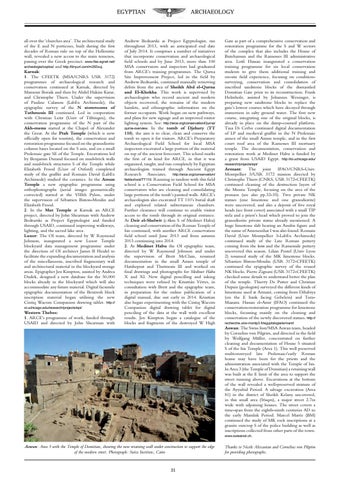
Aswan: The Swiss Inst/MSA Aswan team, headed by Cornelius von Pilgrim, and directed in the field by Wolfgang Müller, concentrated on further cleaning and documentation of House 5 situated S of the Isis Temple (Area 1). This well preserved multi-storeyed late Ptolemaic/early Roman house may have been for the priests and the administration associated with the Temple of Isis. In Area 3 (the Temple of Domitian) a retaining wall was built at the E limit of the area to support the street running above. Excavations at the bottom of the wall revealed a well-preserved stratum of the Ayyubid Period. A salvage excavation (Area 81) in the district of Sheikh Kelany uncovered, in this small area (56sqm), a major street 2.7m wide with adjoining houses. The street covers a time-span from the eighth-ninth centuries AD to the early Mamluk Period. Marcel Marée (BM) continued the study of MK rock inscriptions at a granite outcrop S of the police building as well as inscriptions collected from other parts of the town. www.swissinst.ch. Aswan: Area 3 with the Temple of Domitian, showing the new retaining wall under construction to support the edge of the modern street. Photograph: Swiss Institute, Cairo
31
Thanks to Nicole Alexanian and Cornelius von Pilgrim for providing photographs.