EGYPTIAN
ARCHAEOLOGY
Digging Diary 2013 Summaries of some of the archaeological work undertaken in Egypt during 2013 appear below. The sites are arranged geographically from north to south. ‘Digging Diary’ is very short this issue as many expeditions, including those of the EES, which were due to work in Egypt in the second half of the year, were cancelled or postponed to comply with travel advisories issued by governments concerned about the political and security situations in Egypt. Field Directors who would like reports on their work to appear in EA are asked to e-mail (patricia. spencer@ees.ac.uk ) a short summary, with a website address if available, as soon as possible after the end of each season. PATRICIA SPENCER Abbreviations: EDP Early Dynastic Period; OK Old Kingdom; FIP First Intermediate Period; MK Middle Kingdom; SIP Second Intermediate Period; NK New Kingdom; TIP Third Intermediate Period; LP Late Period; GR Graeco-Roman. Institutions and Research Centres: ARCE American Research Center in Egypt; BM British Museum, London; CFEETK Franco-Egyptian Centre, Karnak; CNRS French National Research Centre; DAI German Archaeological Institute, Cairo; IFAO French Institute, Cairo; MSA Ministry of State for Antiquities, Egypt; OI Oriental Institute, University of Chicago; Swiss Inst Swiss Institute for Architectural Research and Archaeology, Cairo; UMR, USR research groups of the CNRS. SPRING 2013 (March to June) Lower Egypt Giza: An expedition led by Nicole Alexanian (DAI) began documentation in magazines at Giza of reliefs and finds excavated by Ahmed Fakhry in the 1950s in the Valley Temple of the Bent Pyramid at Dahshur. A fresh study of the objects and a new attempt to reconstruct the relief decoration seemed promising as additional relief fragments and finds had been discovered during the current DAI excavations in the Valley Temple. It became clear that not all the published objects are currently stored in the Giza magazines but that they do contain unpublished material found by Fakhry, and many additional relief fragments. The Valley Temple reliefs will be exhibited in the Grand Egyptian Museum, Cairo, and, in preparation, all the objects from Dahshur were cleaned, restored, listed and securely packed. www.dainst.org/de/project/ dahschur?ft=all
Upper Egypt Dahshur: The DAI expedition, directed by Nicole Alexanian and Felix Arnold, completed documentation of the architecture of the Valley Temple of the Bent Pyramid, but due to security concerns excavations could not be undertaken. The brick building N of the temple was investigated and found to predate the stone temple and extend further to the W than previously thought. Cleaning and a magnetic survey revealed that the building originally stood within an enclosure wall. Magnetometry by Tomasz Herbich proved the existence of intensive housing for workmen S of the Red Pyramid (very similar to the barracks in the Gallery Complex at Heit el-Ghurob, Giza) and to the N of the Valley Temple of the Bent Pyramid. Geophysical investigations, undertaken because the modern cemetery was illegally enlarged by villagers to the W, N and S in January 2013, were also carried out near the modern cemetery, located at the mouth of the wadi N and E of the Bent Pyramid. www.dainst.org/de/project/dahschur?ft=all
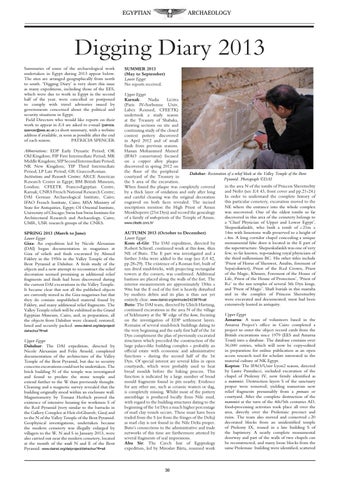
SUMMER 2013 (May to September) Lower Egypt No reports received. Upper Egypt Karnak: Nadia Licitra (Paris IV-Sorbonne Univ, Labex Resmed, CFEETK) undertook a study season at the Treasury of Shabaka, drawing sections on site and continuing study of the closed context pottery discovered in April 2012 and of small finds from previous seasons. Hassan Mohammed Ahmed (IFAO conservator) focused on a copper alloy plaque discovered in spring 2012 on the floor of the peripheral Dahshur: Restoration of a relief block at the Valley Temple of the Bent courtyard of the Treasury in Pyramid. Photograph ©DAI the S area of the excavation. in the area N of the tombs of Princess Sheretnebty When found the plaque was completely covered and Nefer (see EA 43, front cover and pp.21-24.) by a thick layer of oxidation and only after long In order to understand the complete history of and careful cleaning was the original decoration this particular cemetery, excavation moved to the engraved on both faces revealed. The incised NE where the entrance into the whole complex inscriptions mention the High Priest of Amun was uncovered. One of the oldest tombs so far Menkheperre (21st Dyn) and record the genealogy discovered in this area of the cemetery belongs to of a family of wab-priests of the Temple of Amun. a ‘Chief Physician of Upper and Lower Egypt’, www.cfeetk.cnrs.fr/ Shepseskafankh, who built a tomb of c.21m x 14m with limestone walls preserved to a height of AUTUMN 2013 (October to December) c.4m. A long corridor chapel concealing a unique Lower Egypt monumental false door is located in the E part of Kom el-Gir: The DAI expedition, directed by the superstructure. Shepseskafankh was one of very Robert Schiestl, continued work at this kom, 4km few, so far known, top-ranking royal physicians of NE of Buto. The E part was investigated and a the third millennium BC. His other titles include further 3.6ha were added to the map (see EA 42, ‘Priest of Horus of Shenwet, Anubis, foremost of pp.28-29). The existence of a Roman fort, built of Sepa(-district), Priest of the Red Crown, Priest sun dried mud-bricks, with projecting rectangular of the Magic, Khnum, Foremost of the House of towers at the corners, was confirmed. Additional Life, Priest of the House of Protection’, ‘Priest of bastions are placed along the walls of the fort. The Re’ in the sun temples of several 5th Dyn kings, interior measurements are approximately 150m x and ‘Priest of Magic’. Shaft burials in this mastaba 90m but the E end of the fort is heavily disturbed and in the complex of Princess Sheretnebty by modern debris and its plan is thus not yet were excavated and documented; most had been entirely clear. www.dainst.org/en/node/24238?ft=all extensively looted in antiquity. Buto: The DAI team, directed by Ulrich Hartung, continued excavations in the area N of the village Upper Egypt of Sekhmawy at the W edge of the kom, focusing Amarna: A team of volunteers based in the on the investigation of EDP settlement layers. Amarna Project’s office in Cairo completed a Remains of several mud-brick buildings dating to project to enter the object record cards from the the very beginning and the early first half of the 1st British excavations since 1979 (EES and Amarna Dyn complement the plan of previously excavated Trust) into a database. The database contains over structures which preceded the construction of the 36,000 entries, which will now be copy-edited large palace-like building complex - probably an in preparation for online publication as an open official estate with economic and administrative access research tool for scholars interested in the functions - during the second half of the 1st material culture of NK Egypt. Dyn. Of special interest are several kilns in open Koptos: The IFAO/Univ Lyon2 season, directed courtyards, which were probably used to heat by Laure Pantalacci, included excavation of the bread moulds before the baking process. This chapel of Ptolemy IV, now firmly identified as function is indicated by a large number of bread a mammisi. Destruction layers S of the sanctuary mould fragments found in pits nearby. Evidence proper were removed, yielding numerous new for any other use, such as ceramic wasters or slag, relief fragments presumably from a pronaos or is completely missing. Whilst most of the pottery courtyard. After the complete destruction of the assemblage is produced locally from Nile mud, mammisi at the turn of the 4th/5th centuries AD, with regard to the building structures dating to the food-processing activities took place all over the beginning of the 1st Dyn a much higher percentage area, directly over the Ptolemaic precinct and of marl clay vessels occurs. These must have been ruins. The team also moved and conserved c.20 traded from the S (or from the fringes of the Delta) decorated blocks from an unidentified temple as marl clay is not found in the Nile Delta proper. of Ptolemy IX, reused in a late building S of Buto’s connections to the administrative and trade the baptistery. A nearly complete monumental networks of this time are furthermore attested by doorway and part of the walls of two chapels can several fragments of seal impressions. be reconstructed, and many loose blocks from the Abu Sir: The Czech Inst of Egyptology same Ptolemaic building were identified, scattered expedition, led by Miroslav Bárta, resumed work
30