EGYPTIAN
ARCHAEOLOGY
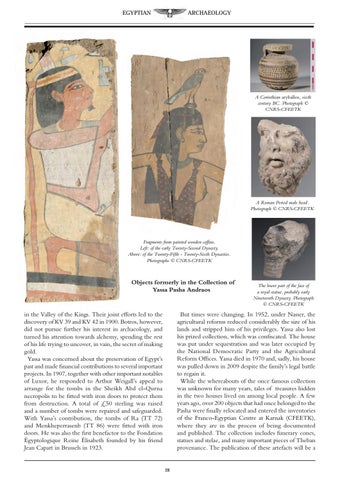
A Corinthian aryballos, sixth century BC. Photograph © CNRS-CFEETK
A Roman Period male head. Photograph © CNRS-CFEETK
Fragments from painted wooden coffins. Left: of the early Twenty-Second Dynasty. Above: of the Twenty-Fifth - Twenty-Sixth Dynasties. Photographs © CNRS-CFEETK
Objects formerly in the Collection of Yassa Pasha Andraos
The lower part of the face of a royal statue, probably early Nineteenth Dynasty. Photograph © CNRS-CFEETK
But times were changing. In 1952, under Nasser, the agricultural reforms reduced considerably the size of his lands and stripped him of his privileges. Yassa also lost his prized collection, which was confiscated. The house was put under sequestration and was later occupied by the National Democratic Party and the Agricultural Reform Offices. Yassa died in 1970 and, sadly, his house was pulled down in 2009 despite the family’s legal battle to regain it. While the whereabouts of the once famous collection was unknown for many years, tales of treasures hidden in the two houses lived on among local people. A few years ago, over 200 objects that had once belonged to the Pasha were finally relocated and entered the inventories of the Franco-Egyptian Centre at Karnak (CFEETK), where they are in the process of being documented and published. The collection includes funerary cones, statues and stelae, and many important pieces of Theban provenance. The publication of these artefacts will be a
in the Valley of the Kings. Their joint efforts led to the discovery of KV 39 and KV 42 in 1900. Botros, however, did not pursue further his interest in archaeology, and turned his attention towards alchemy, spending the rest of his life trying to uncover, in vain, the secret of making gold. Yassa was concerned about the preservation of Egypt’s past and made financial contributions to several important projects. In 1907, together with other important notables of Luxor, he responded to Arthur Weigall’s appeal to arrange for the tombs in the Sheikh Abd el-Qurna necropolis to be fitted with iron doors to protect them from destruction. A total of £50 sterling was raised and a number of tombs were repaired and safeguarded. With Yassa’s contribution, the tombs of Ra (TT 72) and Menkheperrasenb (TT 86) were fitted with iron doors. He was also the first benefactor to the Fondation Égyptologique Reine Élisabeth founded by his friend Jean Capart in Brussels in 1923. 28