EGYPTIAN
ARCHAEOLOGY
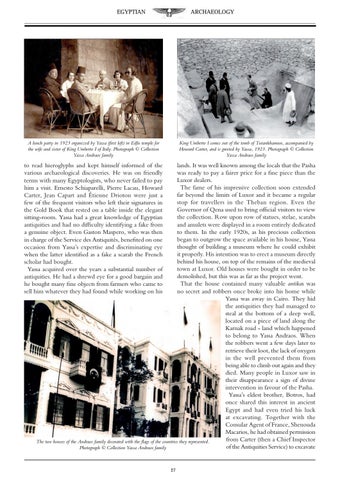
A lunch party in 1923 organized by Yassa (first left) in Edfu temple for the wife and sister of King Umberto I of Italy. Photograph © Collection Yassa Andraos family
King Umberto I comes out of the tomb of Tutankhamun, accompanied by Howard Carter, and is greeted by Yassa, 1923. Photograph © Collection Yassa Andraos family
lands. It was well known among the locals that the Pasha was ready to pay a fairer price for a fine piece than the Luxor dealers. The fame of his impressive collection soon extended far beyond the limits of Luxor and it became a regular stop for travellers in the Theban region. Even the Governor of Qena used to bring official visitors to view the collection. Row upon row of statues, stelae, scarabs and amulets were displayed in a room entirely dedicated to them. In the early 1920s, as his precious collection began to outgrow the space available in his house, Yassa thought of building a museum where he could exhibit it properly. His intention was to erect a museum directly behind his house, on top of the remains of the medieval town at Luxor. Old houses were bought in order to be demolished, but this was as far as the project went. That the house contained many valuable antikas was no secret and robbers once broke into his home while Yassa was away in Cairo. They hid the antiquities they had managed to steal at the bottom of a deep well, located on a piece of land along the Karnak road - land which happened to belong to Yassa Andraos. When the robbers went a few days later to retrieve their loot, the lack of oxygen in the well prevented them from being able to climb out again and they died. Many people in Luxor saw in their disappearance a sign of divine intervention in favour of the Pasha. Yassa’s eldest brother, Botros, had once shared this interest in ancient Egypt and had even tried his luck at excavating. Together with the Consular Agent of France, Shenouda Macarios, he had obtained permission from Carter (then a Chief Inspector The two houses of the Andraos family decorated with the flags of the countries they represented. of the Antiquities Service) to excavate Photograph © Collection Yassa Andraos family
to read hieroglyphs and kept himself informed of the various archaeological discoveries. He was on friendly terms with many Egyptologists, who never failed to pay him a visit. Ernesto Schiaparelli, Pierre Lacau, Howard Carter, Jean Capart and Étienne Drioton were just a few of the frequent visitors who left their signatures in the Gold Book that rested on a table inside the elegant sitting-room. Yassa had a great knowledge of Egyptian antiquities and had no difficulty identifying a fake from a genuine object. Even Gaston Maspero, who was then in charge of the Service des Antiquités, benefited on one occasion from Yassa’s expertise and discriminating eye when the latter identified as a fake a scarab the French scholar had bought. Yassa acquired over the years a substantial number of antiquities. He had a shrewd eye for a good bargain and he bought many fine objects from farmers who came to sell him whatever they had found while working on his
27